
All subjects
Research & Development

Understanding the IPCC Special Report on 1.5°C

In 2015 governments adopted the Paris Agreement to tackle climate change and invited the Intergovernmental Panel on Climate Change (IPCC) to prepare a special report in 2018 to assess the impacts and related pathways of warming of 1.5ºC.

Ahead of the “Special Report on 1.5°C“, scheduled to be published, subject to approval, by the IPCC on October 8, the World Meteorological Organization (WMO) and United Nations Environment Programme (UNEP) have released an explanatory brief.

Entitled “Understanding the IPCC Special Report on 1.5°C“, the brief provides “context and explanation” of key concepts for policymakers, media and others about the Special Report on 1.5°C though it does not contain results from the report itself.
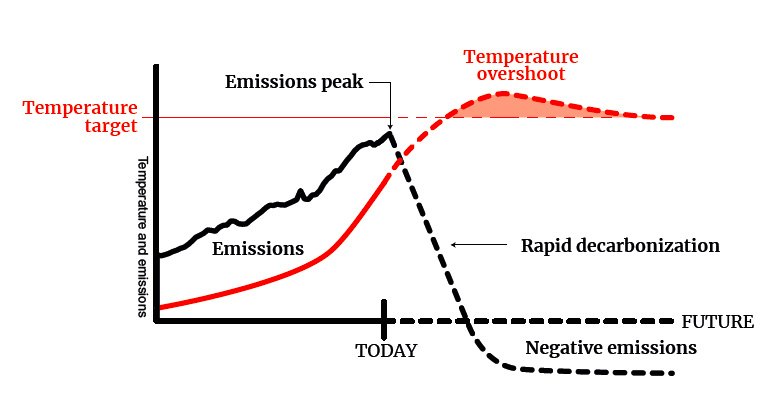
Temperature overshoot is the temporary exceedance of a specified level of global warming, returning to that level before 2100 through carbon dioxide removal (CDR) and/or reductions in emissions of other greenhouse gases. The larger the temperature overshoot and the longer it persists, the harder it will be to return to the original temperature target. Faster and stronger emission reductions may reduce the need for negative emission technologies (illustration courtesy WMO & UNEP).

Most read on Bioenergy International

Get the latest news about Bioenergy

Subscribe for free to our newsletter
Sending request
I accept that Bioenergy International stores and handles my information.
Read more about our integritypolicy here