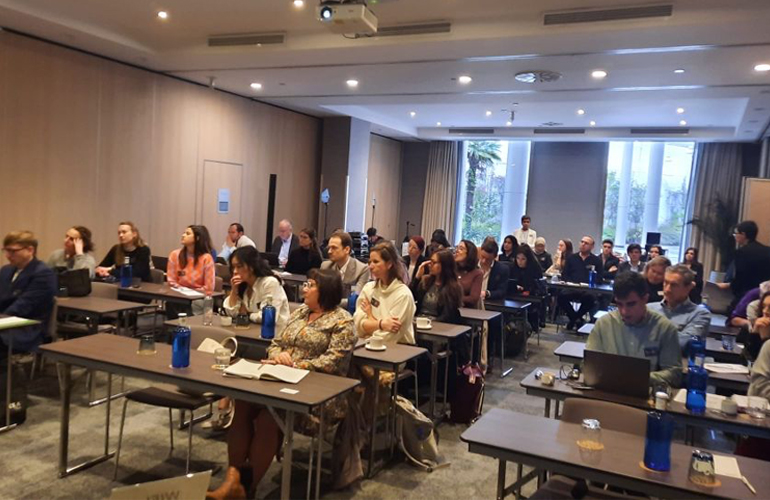
In 2024, European Roundtable on Sustainable Palm Oil (RSPO) Members reaffirmed their leadership at the forefront of sustainable sourcing with an impressive 88 percent uptake of certified sustainable palm oil (CSPO). This success is also reflected in the robust growth of membership in the region, adding 206 new members in 2024 alone. RSPO Trademark licences in the European region also increased significantly from 100 to over 2,600 between 2014 and 2024. These were some of the key figures highlighted during the recently concluded European Members Day of the RSPO held in Madrid, Spain, on February 27, 2025.
Already in its fourth edition, the annual Meet-Up was organised in collaboration with the Spanish Foundation on Sustainable Palm Oil.
Spain has rapidly become a key growth market for RSPO, with membership nearly doubling from 51 in 2020 to 95 in 2024, while RSPO Trademark licenses in the country have tripled from 30 in 2018 to 95 in 2024.
The event gathered over 50 participants from 30 organisations from Italy, Poland, Spain, Switzerland, and the UK.
The day was moderated by Ruben Brunsveld, Deputy Director EMEA at the RSPO, and he highlighted the value of certification in “volatile, uncertain, complex and ambiguous” (VUCA) times and the importance of open discussions.
The Members Meet Up should feel like an open discussion amongst friends. The members are the RSPO, and this is their day, said Ruben Brunsveld.
EUDR developments
A central part of the agenda was the panel discussion on the state of EUDR implementation, which will become binding from December 30, 2025. Participating in the panel were Marta Angoloti Benavides, Head of Unit at the Spanish Ministry for Ecological Transition and Demographic Challenge, Horacio González-Alemán, representative of the Spanish Foundation for Sustainable Palm Oil, and Angeline Camus, RSPO Government Affairs Manager.
We continue to promote sustainability in the Spanish palm oil industry, to tell the general public about the benefits of sustainable palm oil – I see the industry today becoming better; we are evolving in a positive way but we also have to bear in mind that we need more clarity and guidance with the European regulations. Cooperation with the RSPO and anyone interested in sustainability within the palm oil industry is welcome, and we have to work together, said Horacio González-Alemán.
González-Alemán also raised important questions about the implementation of the EUDR, including the challenges posed by the Regulation’s due diligence approach coupled with a ban on imports and high fines in case of non-compliance.
Representing the designated National Competent Authority for the EUDR in Spain, Marta Angoloti Benavides, fueled the discussions with experiences and lessons learned in implementing the EU Timber Regulation within Spain’s specific context, in which the national competent authority must work in partnership with regional competent authorities.
Angeline Camus stressed the importance of closely monitoring EU-level developments and ensuring companies have discussions with their suppliers to be well-prepared, highlighting RSPO’s role as a key risk mitigation factor.
Shared Responsibility to drive customer demand
RSPO’s Head of Certification, Shazaley bin Abdullah, gave an overview of the most recent assurance and certification related updates, highlighting the importance of the recent transition to the prisma by RSPO system – RSPO’s new IT infrastructure for certification, trade and traceability is a key element in the organisation’s efforts to support its members with EUDR compliance.
The Shared Responsibility (SR) Session highlighted how SR plays a crucial role in members’ sustainability journey as meeting SR requirements ensures that they actively contribute to a sustainable palm oil supply chain.
Lorena Posada from RSPO Member, Olenex Holdings B.V., shared insights on driving customer demand for certified material, showcasing how their organisation’s impressive 9.6 in the SR Scorecard reflects a strong commitment to sustainable palm oil practices.
Supply Chain Certification Standard review cycle
Members contributed their creative insights during a workshop focused on the upcoming review of the RSPO Supply Chain Certification (SCC) Standard.
This review takes place every five years as the RSPO updates its standards to keep up with the latest market demands and regulatory developments.
This members-led process kicked off in February and should lead to a new SSC Standard being adopted in 2026.
The Members Meet-Up wrapped up with a session on how to communicate effectively about sustainable palm oil and responsible sourcing.
The session explored ways in which members could leverage the RSPO Trademark and logo, and build consumer awareness and trust through transparency and clear communication.
It was exciting to see longtime RSPO Members sit together with new members who had recently joined the RSPO to discuss pressing issues. Agreeing on the added value of in-person meetings, European members had opportunities to share knowledge and jointly address challenges, which demonstrates RSPO’s importance in providing a space for discussion, offering continued support to our Members in the region, said Francesca Morgante, Head of Global Key Accounts and Market Transformation (Europe) at RSPO.