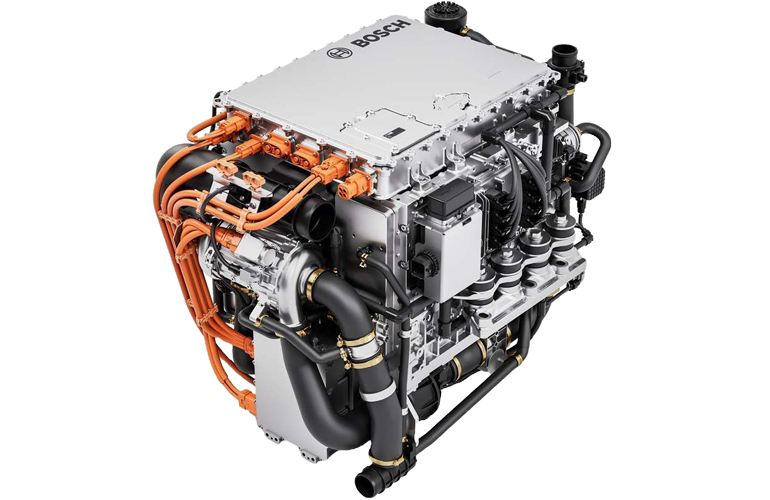
Swedish fuel cell technology developer PowerCell Group AB (PowerCell) has announced that it has received a firm purchase order for a PowerCell PS190 fuel cell system from US-based data center EdgeCloudLink (ECL). In addition, ECL has signed a separate non-binding Memorandum of Understanding (MoU) for approximately 300 MW of additional hydrogen fuel cell (HFC) capacity.
The agreement comprises a firm purchase order for PowerCell PS190 fuel cell systems, alongside a separate non-binding MoU between ECL and PowerCell for approximately 300 MW of additional hydrogen fuel cell capacity as ECL expands its FlexGrid data center footprint.
Initial deployment begins at ECL’s 35MW CSC-1 campus in Santa Clara, California, where containerized PowerCell fuel cell systems will integrate into ECL’s FlexGrid microgrid architecture alongside grid power, natural gas and battery storage.
The partnership is underpinned by PowerCell’s industrial partnership with Bosch, its manufacturing partner and largest shareholder, which provides the manufacturing foundation to deliver at industrial scale.
ECL is among the very few operators who not only run hydrogen in production but understand how to orchestrate it intelligently alongside storage and other energy sources as one integrated system. Our firm order for PowerCell PS190 systems, alongside our broader non-binding MOU, sends a clear signal that hydrogen-powered AI data centers are moving from first-of-kind toward industrial scale, said Richard Berkling, CEO of PowerCell Group.
PowerCell, which spun out of the Volvo Group, brings more than 25 years of fuel cell experience and over one million hours of field data across automotive, marine and stationary power applications.
Backed by Molex Ventures and Hyperwise Ventures, ECL enables scalable, low-carbon compute for AI, high-performance, and edge workloads.
The deployment expands on an existing PowerCell deployment at ECL’s MV-1 facility in Mountain View, California, where hydrogen has been used as the primary power source for more than two years.
Every AI roadmap we see is constrained by power, not imagination, funding or demand. Over the past two years, we have continuously operated and optimized liquid hydrogen-powered AI infrastructure at our MV-1 facility, evaluating multiple fuel cell technologies under real operating conditions before selecting PowerCell. This is not a pilot or a proof of concept — we are deploying these PS190 units with the operational data to back it up, and we are signing an MoU for an additional 300 MW because the demand from AI operators for power in constrained markets far exceeds what any single grid connection can deliver, said Yuval Bachar, founder and CEO of ECL.
Bosch, PowerCell’s manufacturing partner and largest shareholder, provides industrial-scale production and local service capability in North America to support ECL deployments.
Bosch supports this scalable approach by providing the industrial manufacturing foundation. The company also delivers the local North American service needed to integrate these hydrogen systems into core data center infrastructure.
Bringing hydrogen fuel cells to industrial scale requires more than strong technology; it requires manufacturing discipline, predictable quality and dependable lifecycle support. Bosch is proud to bring that industrial foundation to the partnership with PowerCell and ECL. Our goal is to turn promising technology into reliable, long-term infrastructure, said Thilo Müller, SVP Fuel Cell Business at Bosch.
PowerCell’s Distributed Master Controller platform will integrate with ECL’s Lightning real-time management system to manage dynamic load balancing across fuel cells, batteries, the grid, and natural gas at each FlexGrid site.
The approximately 300 MW figure represents a shared ambition under a non-binding MoU and does not represent committed capacity or revenue. Any future deployment would be subject to separate, definitive agreements.