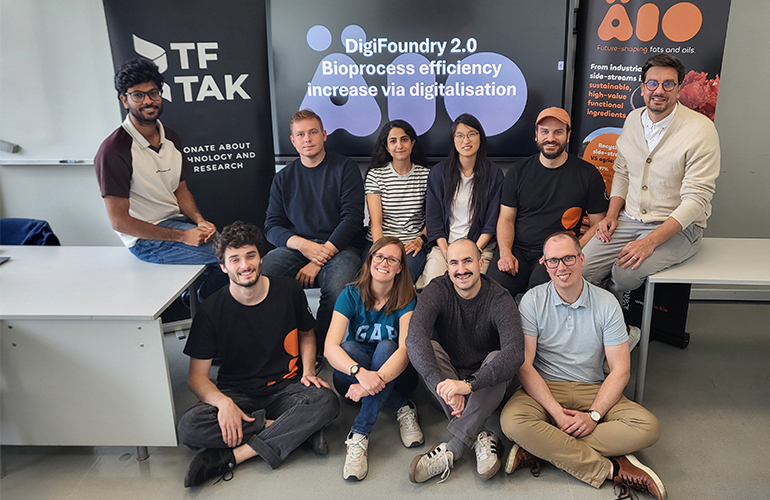
In Estonia, biotechnology company ÄIO and applied research organisation TFTAK have launched DigiFoundry 2.0 – Bioprocess Efficiency Increase via Digitalisation (DF2.0), a three-year research and development project focused on developing next-generation technologies for microbial oil production.
The project has received EUR 1.94 million in funding through the Applied Research Programme (RUP) of the Estonian Business and Innovation Agency (EIS), with a total project budget of approximately EUR 2.53 million.
ÄIO’s project was ranked first among the applications approved in the programme’s 10th funding round. The Applied Research Programme is funded by the Estonian Ministry of Economic Affairs and Communications.
Building on previous project results
DF2.0 builds on the results of the original DigiFoundry project, a collaboration between ÄIO and TFTAK that ran from 2023 to 2026.
The first project focused on creating a prototype platform for automated microbial strain design and establishing a Design-Build-Test-Learn cycle to accelerate the development of microorganisms capable of producing specialised fats through precision fermentation.
The project also included pilot-scale precision fermentation, sensory analysis, and techno-economic assessment of the production process.
The new project takes this work to the next level by connecting biological development with improved fermentation, automation, and digital process control.
The goal is to establish the technological foundation for efficient, scalable, and cost-competitive production of ÄIO’s microbial oils while reducing both development and manufacturing costs and enabling faster development of new ingredients.
With DigiFoundry, we built the foundation. With DF2.0, we are connecting biology, fermentation, and digitalisation into one integrated production system. Our goal is to make microbial oil production not only sustainable, but also highly efficient and economically competitive at an industrial scale. By combining improved fermentation with automation and data-driven process development, we can learn faster, optimise faster, and ultimately produce better ingredients with fewer resources, said Prof. Petri-Jaan Lahtvee, Co-founder and COO of ÄIO and Professor at Tallinn University of Technology (TalTech).
Highly efficient biological production platforms
ÄIO develops fermentation technologies that transform low-value organic side-streams from the food, agricultural and wood industries into high-value oils and fats.
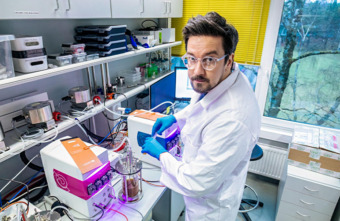
Instead of relying on traditional oil crops or animal-derived fats, microorganisms are used as highly efficient biological production platforms.
This makes it possible to create alternative sources of fats and oils while reducing dependence on agricultural land, climate conditions, and long global supply chains.
ÄIO’s technology can use locally available industrial side-streams as fermentation feedstocks, creating an opportunity to connect local side-streams with local production of valuable ingredients.
The technology is designed to provide alternatives to conventional ingredients such as tropical oils and animal fats, with potential applications across cosmetics, food, and other industries.
ÄIO’s fermentation process can reduce land use by up to 97 percent and water consumption by up to 90 percent compared with conventional production methods, according to company data.
This sustainability positioning is consistent with ÄIO’s previous RUP and scale-up work.
Digitalisation is a key to commercial viability
For ÄIO, digitalisation is a key to making precision fermentation commercially viable.
Biological processes generate large amounts of data, from microbial performance and fermentation conditions to productivity and product characteristics.
Connecting these data points through automated and digital systems can shorten development cycles, improve process control, and help translate laboratory discoveries into reproducible industrial production.
The future of biotechnology is not only about engineering better microorganisms. It is about creating smarter processes around them. If we can understand and control fermentation in real time, we can use resources more efficiently, reduce production costs, and adapt the process much faster to different raw materials and products. That is an important step towards making fermentation-derived fats and oils a real industrial alternative, Prof. Petri-Jaan Lahtvee explained
Fruitful research partnership
DF2.0 continues the research partnership between ÄIO and TFTAK, an Estonian privately owned research organisation focused on accelerating food and biotechnology innovation.
TFTAK works across bioprocess optimisation, food research, analytics and product development, supporting projects from laboratory research and pilot-scale development through to testing in industrial production.
In the original DigiFoundry project, TFTAK contributed to developing the Design-Build-Test-Learn workflow and methods for evaluating microbial products, including sensory analysis and identification of unwanted flavours and aromas.
The collaboration also supported the development of synthetic biology capabilities and microbial screening methods.
In DF2.0, TFTAK will continue contributing its expertise in synthetic biology, precision fermentation and bioprocess development to help connect strain engineering with increasingly automated, data-driven production.
DF2.0 brings together two areas that are essential for the next generation of industrial biotechnology: advanced biology and intelligent process development. By integrating synthetic biology, fermentation and digital tools, we can generate much more information from every development cycle and use that knowledge to make the next cycle better. This collaboration allows us to build technologies that are scientifically ambitious but, importantly, designed from the beginning with industrial application in mind, said Dr Steven van der Hoek, Scientific Lead at TFTAK.
Dr. van der Hoek leads a TFTAK team developing synthetic biology tools and strain-engineering capabilities with a particular focus on precision fermentation.
Step toward broader commercial production
The project comes as ÄIO moves from technology development towards broader commercial production. Since its establishment as a TalTech spin-off in 2022, the company has progressed from laboratory fermentation to tonne-scale production and is developing partnerships for larger-scale manufacturing.
The original DigiFoundry programme reflected an important part of ÄIO’s long-term business model: developing specialised microbial strains capable of producing tailored fats and oils through precision fermentation.
The platform was designed to make strain development faster and more efficient, with the resulting microorganisms intended for ÄIO’s own production and potentially for technology licensing.
DF2.0 expands that concept from the microorganism itself to the entire production process.
By integrating strain development, improved fermentation and digitalisation, ÄIO aims to establish a production platform that can accelerate the development of new ingredients while simultaneously lowering the cost of bringing them to industrial scale.
DF2.0 is about turning side-streams into the oils of tomorrow. Local industries already generate valuable carbon-rich side-streams, and biotechnology gives us tools to turn those resources into something new. With digitalisation and automation, we can make that transformation faster, smarter, and more competitive and build a new generation of ingredients produced locally from resources we already have, concluded Prof. Petri-Jaan Lahtvee.
The DigiFoundry 2.0 – Bioprocess Efficiency Increase via Digitalisation (DF2.0) project runs from July 1, 2026 to June 30, 2029.
Its total budget is EUR 2,531,405, of which a maximum of EUR 1,944,909.40 is provided through the EIS Applied Research Programme.