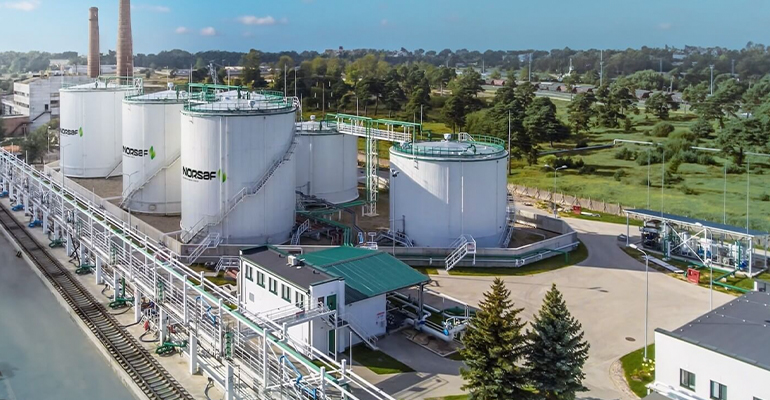
The world’s largest full-service aircraft leasing provider, Avia Solutions Group, together with Latvian partners in the joint venture “NorSAF”, has launched an ambitious project — to build the largest sustainable aviation fuel (SAF) production plant in Northern Europe in the Liepāja Special Economic Zone at the Port of Liepāja, Latvia.
Avia Solutions Group is an ACMI (Aircraft, Crew, Maintenance, Insurance) full-service aircraft leasing provider that manages a fleet of 221 aircraft. The Group offers a range of aviation services including MRO (Maintenance, Repair, Overhaul), pilot and crew training, ground handling, and other related services.
With a capacity of approximately 100,000 tonnes of SAF per annum, the planned NorSAF plant is expected to start production in 2030 as the largest SAF facility in Northern Europe.
It is estimated to require €500–600 million in investment, depending on the selected technology solutions, with implementation depending on support from the EU, institutional investors, and governmental bodies.
Supply SAF to Northern Europe
Starting this year, the EU requires at least 2 percent of all fuel used at airports to be SAF. This mandate will gradually increase — reaching 6 percent by 2030, 20 percent by 2035, and 70 percent by 2050.
For comparison, currently, airports in the three Baltic countries consume about 400,000 tonnes of aviation fuel annually.
With the current EU 2 percent mandate, the local market requires approximately 8,000 tonnes of SAF per annum.
Thus, the SAF produced will be supplied to aviation companies in Northern Europe and exported to markets worldwide.
The NorSAF project marks the Group’s first step into aviation fuel production. Baltic Ground Services, a Group subsidiary with extensive experience in SAF supply and distribution, will implement the project.
Gediminas Ziemelis, Founder and Chairman of the Board of Avia Solutions Group, notes that aviation sector development is directly linked to new sustainability standards.
The currently available SAF production volume is insufficient to meet the growing demand for sustainable aviation fuel in the coming years. The EU regulations foresee an increase in SAF use, rising each year. Once the ‘NorSAF’ plant is operational, it will play a crucial role in ensuring sufficient SAF availability for the aviation sector, emphasized Gediminas Ziemelis.
Swedish Alcohol-to-Jet technology
The new plant will use PureSAF technology, developed by Swedish Biofuels AB and exclusively licensed to the US engineering firm KBR.
Using PureSAF technology, NorSAF will produce both SAF and eSAF, the latter an electro-synthetic aviation fuel made from renewable energy, bioethanol, green hydrogen and captured carbon dioxide (CO2), making the full green energy cycle.
It should be noted that by 2030, another important requirement will come into effect: 1.2 percent of all supplied SAF must be synthetic. This type of fuel is produced without biological components. Instead, green energy is used to generate hydrogen, which is then mixed with carbon dioxide. This requirement will also increase gradually, and by 2050, half of all SAF fuel will have to be synthetic. So, changes in the aviation sector are already underway at full speed, said Vytautas Cekanavičius, CEO of Baltic Ground Services and board member of NorSAF.
A feasibility study being conducted by KBR is expected to be completed in the second half of 2025. Project work is expected to begin shortly thereafter.
Much of the infrastructure we need already exists in the Liepāja Special Economic Zone: gas pipelines and railway lines are available, ethanol transshipment is already ongoing, and a green hydrogen plant is planned. We are currently in talks with a major company from which we could purchase carbon dioxide to use a portion of it in synthetic SAF production, explained Vytautas Cekanavicius.
Board member of LSEZ SIA NorSAF, Janis Kisiels, is confident that the KBR feasibility study will be positive and allow the project to move forward this year so that the plant can begin production by 2030.
NorSAF is working closely with potential suppliers, partners, investors, and EU institutions to begin SAF plant construction as early as 2027. With a proper balance of costs and revenues, Latvia can become a successful platform for the development and export of sustainable fuel production. At the same time, the country would gain access to affordable and sustainable fuel, promoting national economic development and ensuring energy independence. This is crucial in today’s context of geopolitical instability. The project opens lucrative cooperation opportunities for local solar, wind, and biomass energy producers and offers possibilities to expand and produce for export, Janis Kisiels said.