
The production and use of renewable ethanol from members of the European Renewable Ethanol Association (ePURE) reduced greenhouse gas (GHG emissions by an average of more than 75 percent compared to fossil fuels in 2020, according to new certified producer data. It was the ninth consecutive year in which EU renewable ethanol increased its GHG reduction score.
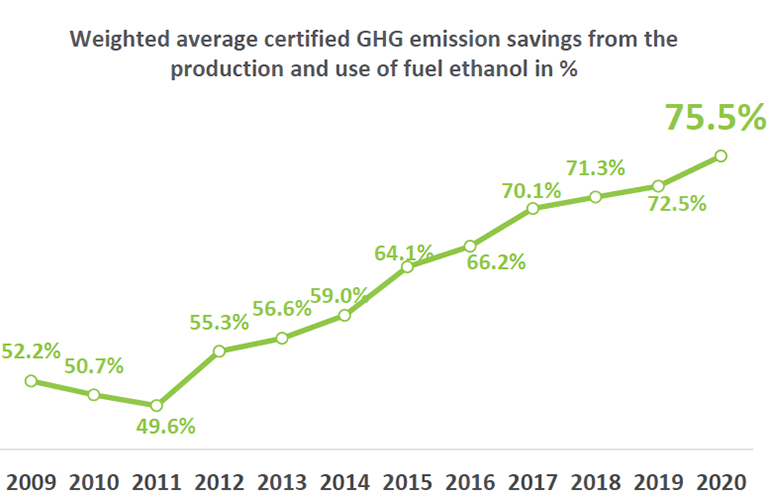
The record-breaking figure strengthens the already convincing case for renewable ethanol as one of the best available tools the EU has for decarbonizing road transport. With the European Commission’s imminent ‘Fit for 55’ legislative package expected to increase targets for emissions reduction and for renewable energy in transport, it is clear the EU will need to make the most of readily available low-carbon solutions such as ethanol.
The numbers clearly show how much Europe’s renewable ethanol sector already contributes to transport decarbonization by helping to displace the use of fossil fuel in road transport and reducing emissions from petrol cars. They also show how much more ethanol could do if the EU policy framework unleashed their potential instead of minimizing their role, said Emmanuel Desplechin, Secretary-General of ePURE.
The record-high GHG-saving performance of ePURE members’ ethanol was also accompanied by a significant production of animal feed, 4.22 million tonnes, and of captured carbon dioxide (CO2), 0.87 million tonnes. The 2020 findings were compiled from ePURE members and certified by auditing firm Copartner.
ePURE’s membership includes 19 producing companies with around 50 biorefineries across the EU27 and UK, accounting for about 85 percent of EU renewable ethanol production.
The arguments against using crop-based EU ethanol in the road transport energy mix are outdated and irrelevant, and sustainability issues have been settled. Increasing its use along with wider deployment of advanced biofuels is the only realistic way the EU can meet its renewable energy goals, ended Emmanuel Desplechin.