As part of National Dairy Month, the American Biogas Council (ABC) has released new data showing continued growth in the number of dairy farms that recycle their manure into renewable energy using biogas capture systems. Currently, 496 American dairies capture energy from their manure, using anaerobic digestion (AD) to recycle it into renewable natural gas (RNG) or renewable electricity.
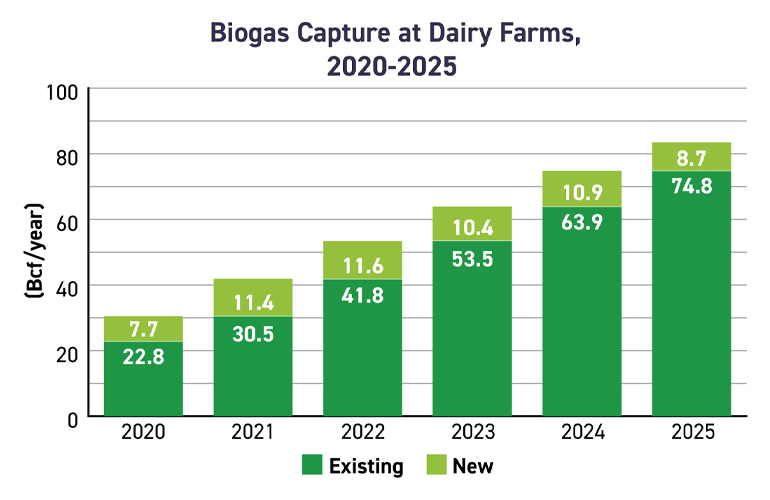
Since the end of 2020, biogas capture from dairy manure has nearly tripled, reflecting growing investment in technologies that support farmers and help meet America’s growing energy demands.
Nationwide, biogas systems recycle manure from approximately 2.5 million dairy cows, putting more than 16 billion (US) gallons (≈ 62 billion litres) of manure to beneficial use every year.
In addition to producing renewable energy, these systems generate nutrient-rich fertilizer products, animal bedding, and reduce manure odor in surrounding communities.
In 2025 alone, 38 dairy farms began capturing biogas from manure, adding capacity to capture approximately 9 billion cubic feet (Bcf) of biogas annually.
Biogas capture from dairy manure now totals about 84 Bcf annually. That energy production capacity equals 52.3 million MMBtu — enough renewable energy to power approximately 680,000 homes each year, or nearly all the households in Idaho.
Significant investment since 2020
Nearly US$4 billion has been invested in dairy biogas projects since 2020, including approximately US$800 million tied to facilities that opened in 2025 alone.
Texas, Idaho, and Wisconsin accounted for more than half of that investment activity last year.
Without biogas systems, farmers typically store dairy manure in open lagoons until it can be spread on farm fields as fertilizer.
With biogas systems, farmers can first capture renewable energy from the manure before recycling the remaining odor-free, nutrient-rich digestate back onto fields, where its nutrients are more readily available to crops.
These projects represent major investments in rural America while helping dairy farmers turn manure into valuable renewable energy and natural fertilizer. The continued growth of dairy biogas systems shows how farmers are adopting technologies that reduce emissions, strengthen farm operations, and create new economic opportunities for rural America, said Patrick Serfass, Executive Director of ABC.
The biogas captured from dairy manure is either upgraded to RNG, which is used interchangeably with natural gas, or is used to generate electricity using engines, linear generators, or fuel cells.
According to this latest data, approximately 65 percent of operational dairy biogas systems upgrade captured biogas into RNG, while the remaining 35 percent use the biogas to generate electricity or heat.
Current dairy biogas systems also prevent the equivalent of approximately one million tonnes of methane emissions from entering the atmosphere each year – comparable to taking about 5.9 million gasoline-powered cars off the road annually.
Substantial untapped potential remains
While growth has accelerated, the ABC estimates that substantial untapped potential remains across the US dairy sector.
Looking at farms with at least 500 cows, approximately 2,955 additional dairy farms could support methane-capturing biogas systems.
Overall, only about 14 percent of potential US dairy biogas projects have been developed.
If fully built out, the remaining potential could produce an additional 186 Bcf of biogas annually — more than double current production levels and enough renewable energy to power an additional 1.4 million US households each year.