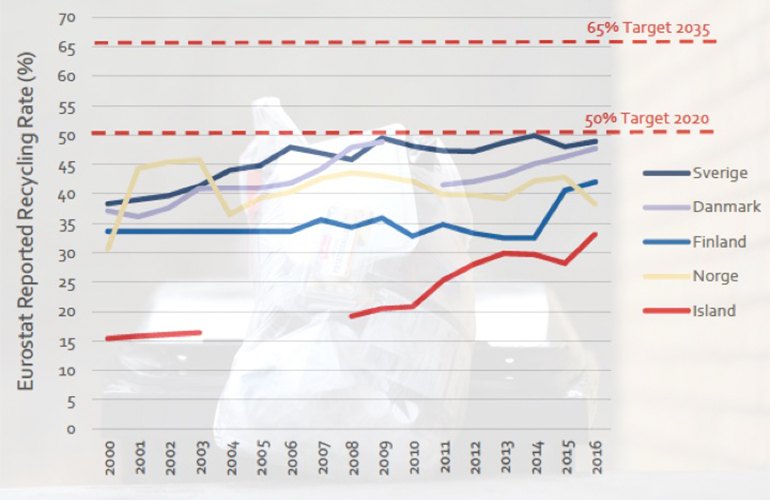
The Nordic nations require a significant increase in recycling rates in order to meet the revised European Union (EU) recycling targets, despite the region including some of the most developed and mature waste management systems in Europe according to a new report commissioned by the Nordic Working Group for the Circular Economy, and the Swedish Environmental Protection Agency (Naturvårdsverket).
European waste policy is at a crossroads with the 2018 circular economy package which makes significant updates to key EU directives including the Waste Framework Directive (WFD), Landfill Directive (LFD), and Packaging and Packaging Waste Directive (PPWD) which have contributed to the shape of Nordic legislation since their introduction. In their 2018 updates, these Directives contain higher targets across the board for recycling, they also limit the quantity of landfill permitted and put in place higher standards for recycling collections.
Carried out by UK-headed consultants Eunomia, the report ‘Analysis of Nordic Regulatory Framework and its Effect on Waste Prevention and Recycling in the Region’ was commissioned by the Nordic Council of Ministers Waste Group (NWG), now part of the Nordic Working Group for the Circular Economy, and the Swedish Environmental Protection Agency (Naturvårdsverket) in order to give them a better understanding of the effect of existing policy on the management of household waste.
Significant recycling rate increase needed
Of the Nordic countries reporting their recycling rate to Eurostat, the report found that an increase of between 16-32 percent is required to meet the new EU target of 65 percent by 2035. This gap is likely to look even greater once reporting of recycling is aligned with tougher new EU rules. The figures are based on an analysis of the existing Nordic regulatory framework, and the impact of policies on waste prevention and recycling in the region.
The analysis found that, despite the success of the existing policy, significant changes will be required in order for the region to meet the revised EU targets.
In-depth policy analysis for Denmark, Norway, Sweden, Finland, and Iceland found that implementing deposit refund systems (DRS) for metal containers, alongside Extended Producer Responsibility (EPR) systems and landfill bans on both combustible waste and biodegradable waste all had a significant positive effect on recycling rates.
However, the research also found that, despite the success of the existing policy, significant change will be required in every nation of the Nordic region in order to achieve the targets set out in the revised EU waste directives. Specifically, a significant shift is required away from incineration and in Iceland, landfilling towards recycling.

The report proposed a number of changes to support this shift. Key actions would include a dramatic increase in recycling collection coverage from households and businesses, as well as a reform of waste management policy to include leverage of additional taxation measures. These actions would be supported by the development of new recycling and biowaste infrastructure and the use of a wider range of behaviour change interventions.
The report also concluded that, in order to meet recycling targets, it will be necessary for the economics of recycling to be made more attractive or for other policies to regulate in its favour.
With the 2018 circular economy package making significant updates to key European Union directives, it’s great to see the Nordic region focused on how it can make changes to move towards a truly circular economy. The report shows that the nations face common challenges, and despite the many differences between them, it seems an ideal time for the region to accelerate cooperation and collaboration in this area to bring about meaningful change, said Camilla Durrant, Senior Consultant, Eunomia.