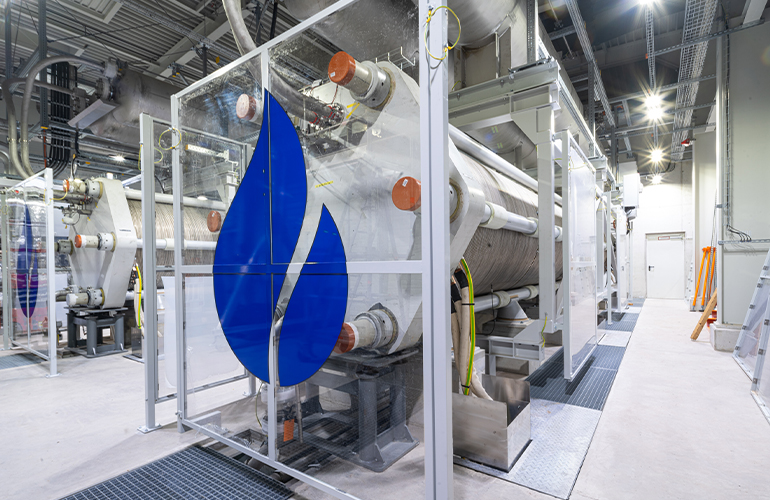
In Germany, energy utility major RWE AG has commissioned an electrolyzer pilot plant in Lingen. The facility on the site of RWE’s Emsland gas-fired power plant has a capacity of 14 MW and it can generate up to 270 kilogrammes (kg) of green hydrogen per hour using electricity from renewable sources.
Featuring two different electrolysis technologies, the aim of the pilot plant is to provide valuable insights for developing future industrial-scale hydrogen facilities.
The first large commercial electrolyzer plant is already being built only meters away as part of the GET H2 Nukleus project, a 100-MW electrolyzer is to be commissioned there by 2025, with its capacity to be expanded to 300 MW by 2027.
Lingen is one of the most exciting locations of the German energy transition. In addition to operating our flexible gas-fired power plant and our state-of-the-art large-scale battery system, we are now also producing green hydrogen here. Over the coming years, we will expand our production capacities for green hydrogen at this site further to supply industrial consumers with green molecules and thus support them in their decarbonization efforts. Together with our partner companies, our teams are pioneering these innovative technologies here. The hydrogen economy is extremely complex. With the core grid, an import strategy, domestic hydrogen production, and hydrogen storage facilities we have a target picture of the future. We can see a part of this vision becoming reality here and now, Markus Krebber, CEO of RWE.
Public co-financing
The Lower Saxony Ministry for the Environment, Energy, and Climate Protection provided EUR 8 million in funding for the pilot electrolyzer that has just been commissioned.
By supporting hydrogen along the entire value chain, we are taking an important step towards a climate-neutral and sustainable economy in Germany. The federal government and state governments are collaborating closely to create the right conditions for climate-neutral economic growth. I am convinced that electrolyzers like this one here in Lingen will make an important contribution toward a successful energy transition. The green hydrogen generated in the electrolyzers here will be a key component for the decarbonization of industry and the energy sector in Germany, commented Robert Habeck, Federal Minister for Economic Affairs and Climate Action.
The company has also been granted funding from the federal government and the state of Lower Saxony of over EUR 490 million for constructing the 300-MW electrolyzer as part of the GET H2 Nukleus project.
RWE uses the pilot plant to gain valuable insights into developing and operating industrial-scale systems.
The pioneering work that is being done in Lingen is exemplary. Here, we see how industry can be decarbonized successfully in an impressive manner. The production of green hydrogen on an industrial scale supported financially by us as the state government here at RWE, is a key prerequisite for successfully transforming our energy supply and our industry towards becoming climate-neutral. Within Germany, the state of Lower Saxony is leading the way in terms of investments in this technology. Fifty percent of Germany’s green hydrogen production as recently approved by the EU is to come from Lower Saxony, said Minister President Stephan Weil.
Two sub-systems
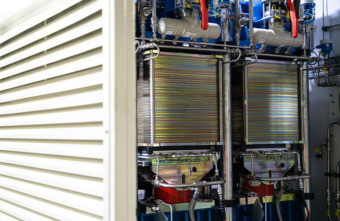
The pilot electrolyzer plant consists of two sub-systems – an alkaline electrolyzer from Sunfire with a capacity of 10 MW and a 4 MW plant, designed and built by Linde using a proton exchange membrane (PEM) electrolyzer from ITM Power.
Initially, the hydrogen produced in the pilot plant is to be added to the fuel for the power plant’s unit D gas turbine as part of a comprehensive test program at the site.
From mid-2025, it will also be possible to fill hydrogen-powered vehicles with hydrogen from the pilot plant at the Emsland gas-fired power plant.
The construction work for a hydrogen filling station and a trailer filling facility for hydrogen has already commenced.
Lingen key to hydrogen economy ramp-up
Together with strong partners, RWE is part of the GET H2 initiative that aims to build the first hydrogen infrastructure in Germany that is accessible to the public.
The GET H2 Nukleus project connects the production facilities for green hydrogen in Lingen to industrial consumers in Lower Saxony and North Rhine-Westphalia.
The grid, spanning 130 km from Lingen to Gelsenkirchen, is to become the first hydrogen grid in the regulated sector with transparent prices and providing non-discriminatory access.
In this way, the initiative wants to contribute towards significantly accelerating the ramp-up of the hydrogen economy and help companies in the industrial and mobility sectors to reach their climate targets.Shell Lower Saxony is to become a hub for producing, importing, storing, transporting, and using hydrogen. We are thus on a good trajectory towards developing into Germany’s number-one hydrogen state. Now, it is important to grow the industrial demand for hydrogen further and create the best possible conditions for utilizing electricity from renewable sources in an even more targeted manner rather than having to curtail production in order to prevent congestion on the electricity grids, said Minister President Stephan Weil.