The Roundtable on Sustainable Palm Oil (RSPO) 16th Annual Communication of Progress (ACOP 2025) reporting cycle, covering January 1 to December 31, 2025, highlights a transformative period for certified sustainable palm oil (CSPO) amidst evolving global regulatory benchmarks, macroeconomic headwinds, and geopolitical tensions.
Over the past four ACOP cycles, RSPO members have demonstrated strong reporting compliance, maintaining an average submission rate of approximately 95 percent, with mandatory submitters reaching a 95.8 percent response rate in 2025.
Detailed data and information are available through the RSPO ACOP dashboard.
According to RSPO, these “robust submissions are key for accurately understanding and reporting on market dynamics, to identify areas where members require assistance, and promote transparency in the overarching vision of making palm oil sustainable.”
Upstream trends
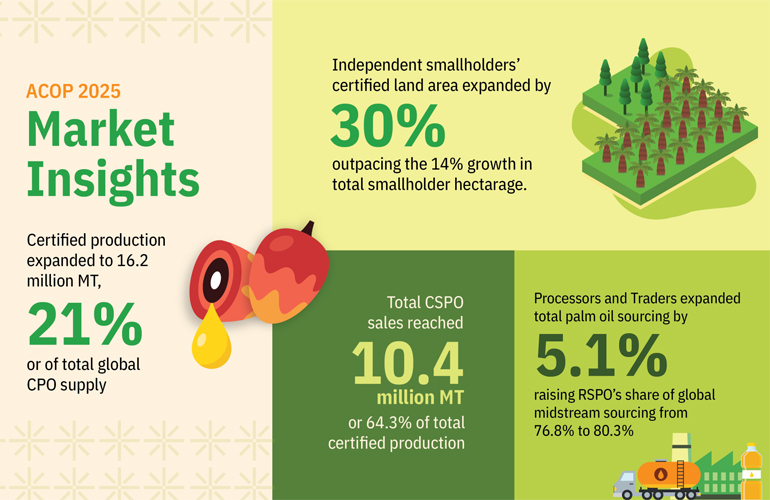
Overall, certified production demonstrated resilience, expanding to 16.2 million tonnes, representing 21 percent of total global crude palm oil (CPO) supply.
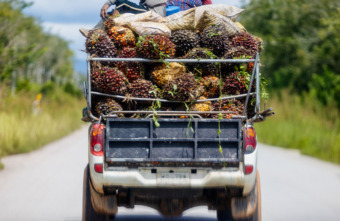
In the upstream sector, certified production gains were primarily driven by yield recovery across Southeast Asia, offsetting a reduction in volumes in Latin America due to certification disruptions.
Indonesia expanded its Certified Sustainable Palm Oil (CSPO) production by 6.6 percent, continuing to account for more than half of the global supply.
Member coverage in Thailand rose significantly to encompass 44.5 percent of national CPO output, with 8.4 percent generated as certified volume.
Despite experiencing regional supply disruptions, Latin America maintained the highest member coverage globally, with 63.5 percent of total CPO under RSPO Member operations.
Meanwhile, production across Malaysia and Africa remained steady, contributing certified shares of 19.0 percent and 17.4 percent of their respective regional totals.
Among independent smallholders, certified land area expanded by 30 percent, significantly outpacing the 14 percent growth in total smallholder hectarage.
Market transactions and sourcing
Market transactions for CSPO underwent a pronounced transition across supply chain options, a shift that RSPO is closely monitoring for significance and scale.
Buyers shifted demand away from RSPO Credits, which experienced a 38.6 percent drop, and redirected purchasing toward traceable physical models such as Mass Balance (MB) and Identity Preserved or Segregated (IP/SG) supplies.
Conversely, Independent Smallholder Credits (IS-Credits) saw strong growth of 37.7 percent.
Total CSPO sales reached 10.4 million tonnes, representing 64.3 percent of total certified production, while overall uptake accounted for 12.1 percent of global domestic CPO consumption.
Midstream and downstream segments
Midstream and downstream segments reflected contrasting purchasing behaviors across supply chain models.
Processors and Traders expanded their total palm oil sourcing by 5.1 percent, raising RSPO’s share of global midstream sourcing from 76.8 percent to 80.3 percent despite trade disruptions and rising logistics costs.
Physical CSPO sourcing in this segment grew by 1.6 percent, led by a 9.4 percent rise in IP/SG volumes as companies pre-positioned for plot-level traceability standards.
Further downstream, market headwinds and trade disruptions appear to have influenced sourcing and purchasing trends in 2025.
Consumer Goods Manufacturers saw a slight 4.1 percent dip in overall sourcing, with a 27.7 percent contraction in credit purchases outweighing a 4.2 percent gain in physical procurement.
Retailers experienced an 8.8 percent decline in total palm oil sourcing due to softer consumer demand, yet their physical certified procurement held up far better than credits, showing a clear preference for Segregated and Identity Preserved supply chains.