
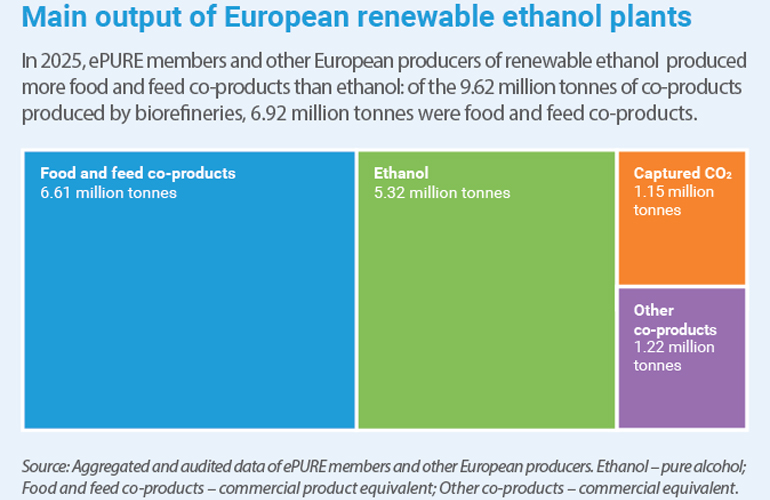
European ethanol biorefineries produced more food and animal feed than fuel in 2025, according to audited data released by ePURE, the European Renewable Ethanol Association. Independently certified data show significant production of food, feed and captured biogenic carbon dioxide along with renewable fuel in 2025, underlining the strategic importance of domestic ethanol biorefineries.
The statistics were compiled from ePURE members and other European renewable ethanol producers and certified by the auditing firm Copartner.
ePURE members – representing 85 percent of EU installed ethanol production capacity – and other European producers of renewable ethanol produced 6.61 million tonnes of food and feed co-products and 5.32 million tonnes of renewable ethanol last year, according to the audit.
European renewable ethanol biorefineries also produced 1.15 million tonnes of captured biogenic carbon dioxide (bioCO2), which replaces fossil CO2 in various industrial applications including beverages and greenhouses.
Domestically produced bioCO2 will also be of increasing importance as one of the main feedstocks for the production of electrofuels (efuels).
At a time when food security, energy independence and industrial autonomy are of vital strategic and economic importance, Europe needs domestic renewable ethanol production more than ever. Forget the ‘food vs. fuel’ nonsense. With European ethanol biorefineries, fuel is a byproduct of food and feed production, said Laurent Donceel, Secretary General of ePURE, the European Renewable Ethanol Association.
Nearly all of the crops used by the audited biorefineries were grown by European farmers, while 82.5 percent of the renewable ethanol produced was for fuel use.
Of the remaining ethanol production, 10.4 percent was for industrial use, including hand sanitiser, and 7.1 percent was for food and beverage use.
The audit also showed record-high greenhouse gas (GHG) saving performance of European producers’ ethanol – 82 percent on average compared to fossil petrol.
According to ePURE, this continually improving carbon intensity score “confirms the importance of European renewable ethanol as a domestic solution to reducing emissions from petrol and hybrid cars.”