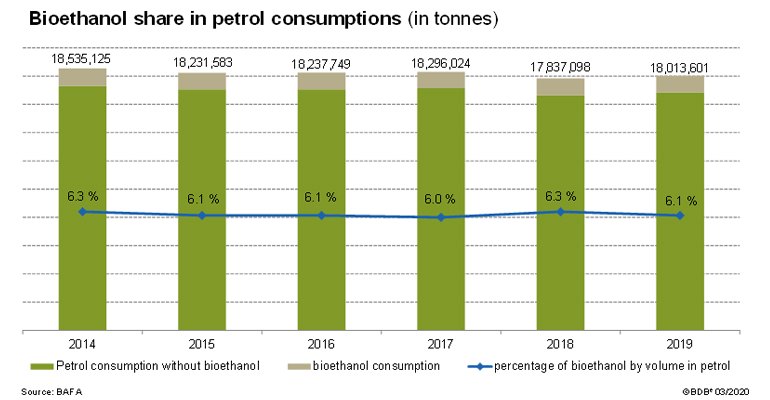
The German Bioethanol Industry Association (BDBe) has published the 2019 market data for the production and consumption of certified sustainable bioethanol. German bioethanol production, standardised for use as fuel, fell 2019 to 542 699 tonnes – which is 12.8 perent less than in the previous year. Sales of bioethanol were roughly on par with the previous year, with the market share of Super E10 rising by almost one percentage point to 13.7 percent.
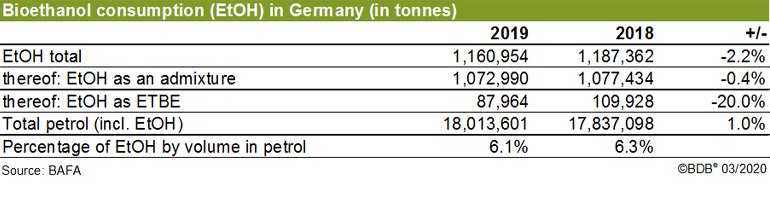
According to the Bundesverband der Deutschen Bioethanolwirtschaft (BDBe) report, in a fuel market that increased again slightly in 2019 with petrol sales of 18.0 million, about one percent more than in the previous year (2018: 17.8 million tonnes), the consumption of bioethanol blended with Super E10, Super Plus and Super (E5) fuel or used to produce ETBE (ethyl tert-butyl ether), fell slightly to just under 1.16 million tonnes.
Nearly 88 000 tonnes of bioethanol was used for ETBE production, which is about 20 percent less than in the previous year. In contrast, the market share of the fuel Super E10, which contains up to 10 percent bioethanol rose, from 12.9 percent in 2018 to 13.7 percent. At 2.46 million tonnes, the sales volume was over 6 percent higher than in the previous year (2018): 2.31 million tonnes).
A drop in domestic production
Domestic production of bioethanol for use as an additive in fuel fell by 12.8 percent to just under 543 000 tonnes. Compared to the previous year with a production volume of 622 232 tonnes, this represents a significant decline.
This was due in part to an alignment of production with the more challenging market conditions at the beginning of 2019, which were characterised by weaker demand and volatile and falling prices for bioethanol.
On the positive side, motorists’ confidence in Super E10 has increased again, even though bioethanol sales stagnated overall last year. The increase in the greenhouse gas savings quota from four to six percent at the beginning of the year also meant that bioethanol consumption in January 2020 was already almost six per cent higher than in the previous month of December, explained Stefan Walter, Managing Director of BDBe.
However, given the effects of the coronavirus (COVID-19) pandemic that have been felt throughout Europe since March 2020, forecasts for the remainder of 2020 are difficult.
Currently, the demand for bioethanol for use as an admixture in petrol is declining significantly throughout Europe because the demand for fossil fuels has also fallen due to output and contact restrictions. At the same time there is enormous demand for bioethanol as a basic material for the production of disinfectants. In the coronavirus crisis, our companies are now flexibly providing quantities of bioethanol as a basic material for disinfectants that are so urgently needed to protect public health. Regardless of the current reciprocal effects and uncertainty on the market, bioethanol in the form of alternative fuels will continue to play an important role in the future, said Stefan Walter.
Renewable fuels for engines needed
According to BDBe, there are currently around 47 million cars registered in Germany. More than 31.4 million of them have a petrol (gasoline) engine, which is more than ever before. In the medium term, the major car manufacturers are planning considerable investment in the further development of the internal combustion engine (ICE).
This suggests that renewable fuels will be needed for a long time to come in order to achieve climate targets.
In the wake of the coronavirus pandemic, it will be important to significantly increase the blending ratio of certified sustainable bioethanol in petrol: by increasing sales of Super E10 and quickly introducing petrol with more than 10 percent bioethanol content to the market, concluded Stefan Walter.