The Asian Infrastructure Investment Bank (AIIB) and the International Renewable Energy Agency (IRENA) have signed a Memorandum of Understanding (MoU) committing to work together to support Asia’s energy transition and mobilize greater private capital for renewable energy.
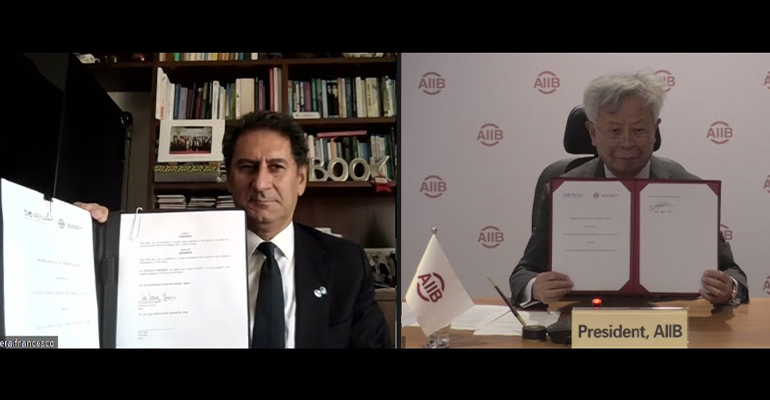
Under the terms of the AIIB-IRENA MoU, both the Bank and IRENA agreed to scale up their efforts to unlock capital and accelerate the uptake of renewable energy by AIIB members.
AIIB President Jin Liqun remarked upon how the Bank and IRENA will work together to accelerate investment and enhance awareness of renewable energy solutions throughout Asia.
With Asia’s growing energy demand, and the rising challenges from climate change, we need to ensure the region invests more than ever in renewable energy and energy efficiency to facilitate their transition to the low carbon energy mix. This partnership is part of the Bank’s journey toward realizing the goals set out in the Paris agreement, President Jin Liqun said.
IRENA Director-General, Francesco La Camera, highlighted this agreement bolsters IRENA’s efforts to facilitate the flow of low-carbon capital into the energy transition where it is needed most, including through the Climate Investment Platform (CIP), a multi-stakeholder initiative designed to mobilize climate capital, of which IRENA is a founding member.
The Climate Investment Platform (CIP) was launched at the United Nations Secretary General’s Climate Action Summit in 2019, as an inclusive partnership to scale up climate action and translate ambitious national climate targets into concrete investments on the ground. Apart from IRENA, the founding partners include SEforALL, and United Nations Development Programme (UNDP) in coordination with Green Climate Fund.
The energy transition is the centerpiece of global efforts to achieve sustainable development, address climate change and accelerate a new age of inclusive, low-carbon growth. Through partnerships like this, we can catalyze the flow of capital towards renewables and energy transition-related infrastructure to build a more resilient, sustainable, and inclusive system, said Francesco La Camera.
Asia picking up the energy transition pace
Currently, Asia is home to about 60 percent of the world’s population and contributes to almost 50 percent of global energy-related greenhouse gas (GHG) emissions.
According to IRENA, the region accounts for nearly half of global renewable energy capacity, up from less than one-third a decade ago. However, relative to its size, Asia still lags behind, with renewables accounting for less than 15 percent of total primary energy consumption in 2020.
Furthermore, developing countries in Asia are expected to account for about two-thirds of global energy growth by 2040. With its vast wealth of affordable and sustainable energy resources, such as hydropower, wind, and solar, it is essential that this growth is met by renewable energy capacity.
Under its Corporate Strategy, AIIB will aim at reaching or surpassing by 2025 a 50 percent share of climate finance in its actual financing approvals, reflecting its commitment to support the Paris Agreement. Its Sustainable Energy for Asia Strategy (2017) also sets out a clear framework for how the Bank will invest in energy projects that increase access to clean, safe, affordable, and reliable energy for millions of people across Asia.
The Bank is partnering with IRENA to support AIIB’s green mandate and help the Bank achieve its ambitious climate finance targets. AIIB is already playing an important role in increasing private sector investment in the renewable energy sector.
Over the last five years, AIIB has invested in 12 renewable energy projects, amounting to US$1.25 billion in Egypt, India, Kazakhstan, Maldives, Oman, Pakistan, Tajikistan, Turkey, and Nepal.
Further, 71 percent of AIIB-financed installed power capacity was in renewable energy with about 940 MW renewable energy capacity added annually. AIIB has also invested at least US$500 million in on-lending for renewable energy projects through financial intermediaries such as the Tata Cleantech Sustainable Infrastructure On-Lending Facility in India and the SUSI Energy Transition Fund dedicated to Southeast Asia.
IRENA has been instrumental in mobilizing finance for renewable energy deployment. Through its partnership with the Abu Dhabi Fund for Development (ADFD), under the IRENA/ADFD Project Facility, it has supported transformative renewable energy projects in developing countries across Africa, Asia, Latin America, the Caribbean, and the Pacific.
Under the Facility, US$350 million in concessional loans was committed over seven annual funding cycles, assisting 32 projects in 26 countries.