In Japan, Mitsubishi Heavy Industries Engineering Ltd (MHIENG), a group company of Mitsubishi Heavy Industries Ltd (MHI), has announced that it has received an order for a compact carbon capture system from compatriot Taihei Dengyo Kaisha Ltd (Taihei Dengyo), a provider of plant construction, maintenance, and auxiliary services. The carbon dioxide (CO2) capture unit will be incorporated into an existing 7 MWe biomass power plant in Hiroshima City.
Taihei Dengyo is targeting the establishment of carbon-negative solutions from a carbon-neutral system, to help realize a circular society. The company seeks to achieve this shift through separation, capture, and initial storage of the CO2 emitted by biomass power plants, followed by the use of the stored carbon.
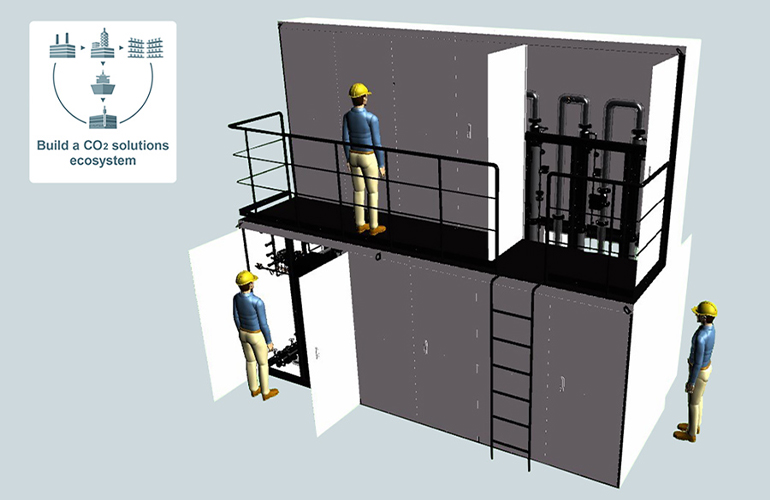
The introduction of the newly ordered compact CO2 capture system is part of that initiative. The unit will be integrated into a 7-MW class biomass power plant operated by Taihei Dengyo in “Hiroshima Seifu Shinto,” an urban complex within Hiroshima City. The system offers a capture capacity of 300 kilos per day (tpd).
Based on Drax BECCS pilot
The newly ordered system is based on a test plant manufactured to verify the impact of applying the new CO2 capture system to a biomass flue gas source, which made early commercialization possible.
The base system is a pilot facility used in the bioenergy with carbon capture and storage (BECCS) project conducted at the Drax Group plc biomass power plant in Selby, UK. The basic configuration has been upgraded with the addition of automated operation and other functions for commercialization.
According to MHIENG, the system on order is easily installed, requires an installation space of modest size – only 5 meters in length and 2 meters wide – and can be transported from the factory by truck. It features a modular design enabling mass production, and its highly versatile standardized design reduces investment, operation, and maintenance (O&M) costs and results in faster delivery.
For these reasons, the new system can respond to a broad range of needs to cut carbon emissions at relatively compact facilities in the industrial sector. Going forward, the system lineup will be expanded to enable carbon capture from diverse emission sources worldwide.
MHIENG expects to provide operational support services using its proprietary remote monitoring system, and thereby aims to put in place a fully integrated customer support structure from system design to after-sale servicing.
Amine solvent system
The CO2 capture technology adopted in the new system is the Kansai Mitsubishi Carbon Dioxide Recovery Process (KM CDR Process), jointly developed by MHIENG and Kansai Electric Power Co., Inc. (KEPCO), which employs the high-performance “KS-1” amine solvent. The technology significantly reduces energy consumption.
As of November 2021, MHIENG has delivered a total of 13 commercial plants using the KM CDR Process at various locations worldwide, and two more plants are currently under construction.