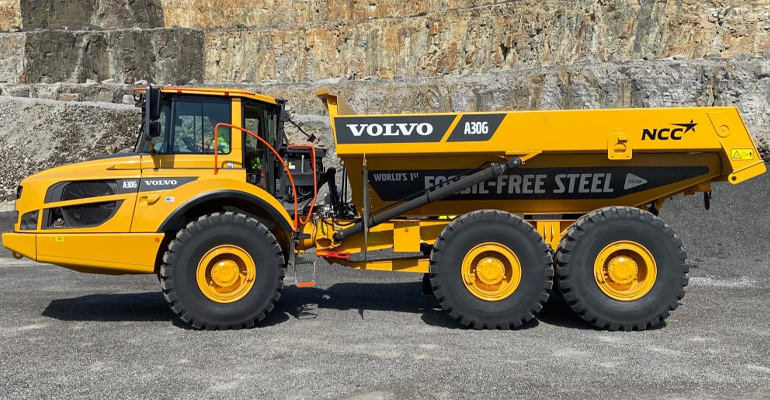
The world’s first construction machine built using fossil-free steel has arrived at NCC’s quarry in Södra Sandby, near Lund, in southern Sweden. The machine, an A30G articulated hauler, was manufactured by Volvo Construction Equipment (Volvo CE), using fossil-free steel from SSAB, and will be used daily by NCC in its operations at the quarry.
The A30G articulated hauler was first presented to the Nordic building and construction major NCC Group by Volvo CE at a ceremony in conjunction with the United Nations’ environmental meeting Stockholm +50 earlier this year.
The world is dependent on growth at the same time as we reduce our carbon footprint. Volvo Group works continuously with customers, suppliers, and partners to develop sustainable machines and total-package solutions, said Melker Jernberg, President of Volvo CE.
The A30G was manufactured at Volvo CE’s Braås facility in Sweden using fossil-free steel from the steel company SSAB.
As such it has a much lower carbon footprint than a machine made from conventional steel.
The articulated hauler now entering service with NCC marks the beginning of the shift toward fossil-free construction and is the first made of fossil-free steel to be delivered to a customer. Turning words into actions is key to building the world we want to live in, Melker Jernberg said.
At NCC’s quarry in Södra Sandby, the articulated hauler will be used in the production of stone materials for new roads, infrastructure, buildings, and other construction projects.
The machine is fuel-efficient and will operate on renewable diesel (HVO).
It is thrilling to have this globally famous piece of equipment on-site at NCC’s quarry. For the foreseeable future, society is dependent on stone and rock materials for building the infrastructure that is required. Accordingly, it is important that we conduct operations sustainably at our quarries. Here is an example of equipment and technology that can contribute to reduced emissions, said Ylva Lagesson, Head of NCC Industry.
NCC and Volvo Group have collaborated for several years to identify innovative solutions and new technology that can advance the development and which are aligned with NCC’s sustainability targets.
For example, the parties are working with efficient loading methods to reduce the number of transport journeys in the West Link project in Gothenburg.
Long-term and proactive partnerships like the one we have here in southern Sweden with Volvo CE and SSAB are needed if the sustainability transition is to be possible. My hope is that the Södra Sandby quarry can continue as a site where we test new technology and sustainable solutions, concluded Ylva Lagesson.