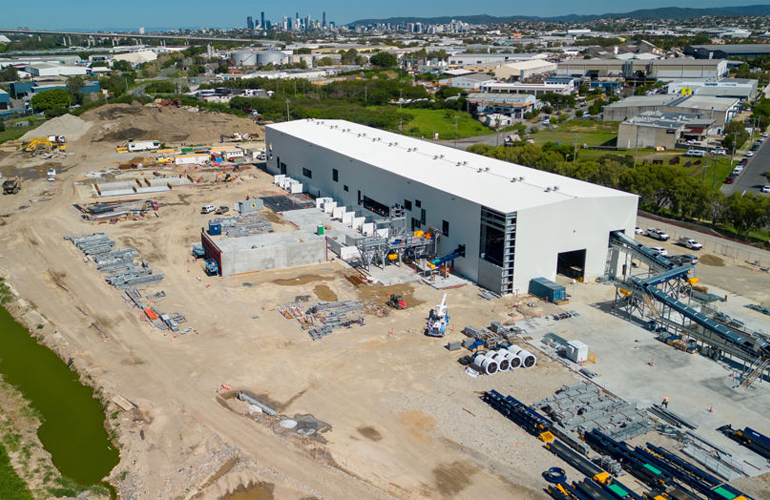
In Australia, the Clean Energy Finance Corporation (CEFC) has announced that it is committing AU$75 million in debt finance to develop what will be Queensland’s flagship construction and demolition (C&D) recycling facility, substantially boosting Australia’s recycling sector and expanding onshore recycling capabilities.
The new integrated plant – one of Australia’s largest for throughput volume under one roof – will be able to process more than one million tonnes of C&D waste annually, including concrete, excavation material, vacuum waste and skip bin waste, diverting a significant amount of valuable resources from landfill.
With a recovery rate of more than 90 percent, it will produce higher-quality recycled products for reuse.
Largest recycling investment to date
The CEFC investment in the Rino Recycling facility in Queensland (QLD) is the single largest to be made via its AU$100 million Australian Recycling Investment Fund.
This investment helps provide a solution to Australia’s growing waste stream and accelerates our transition to a circular economy by deploying best-in-class technology to further develop our recycling sector. It offers an opportunity to deliver important infrastructure to Queensland and comes at a critical time for Brisbane, with the city on the cusp of a construction boom in the countdown to the 2032 Olympics, said Ian Learmonth, CEO of CEFC.
Rino Recycling was established by Queensland Recycling Technologies (QRT), a joint venture between Alceon Qld and Edward Bull of Real Estate and Private Equity investor DCP.
The organization’s flagship 8 ha site in Pinkenba, currently processes approximately 500 000 tonnes of waste annually.
Brisbane is expected to continue the trend of significant population growth over the next 20 years, in addition to the construction requirements of the 2032 Brisbane Olympic Games. The city has a significant pipeline of infrastructure development, including the expansion of the Brisbane Airport and the development of the Brisbane city region in the SEQ ‘City deal’. The potential for recycling building materials in these construction projects is very large, and it’s great to be working with the CEFC to help establish this plant and contribute to a more sustainable Olympics, said Todd Pepper, Director of Rino Recycling.
Landfill levy set to double

Less than a third of all construction and demolition waste around the world is recovered and reused according to World Economic Forum’s “Shaping the Future of Construction: A Breakthrough in Mindset and Technology“ report from 2016.
According to Australia’s National Waste Report 2022, 29 million tonnes of waste came from the C&D sector last year, amounting to 38 percent of all waste generated in Australia, a significant proportion of which is sent to landfill.
The introduction of the landfill levy by the Queensland Government in 2019, and their commitment to almost double it by 2027, has enabled us to make this investment in this proven technology. This facility will not only help SEQ achieve its Olympics commitments but preserve a number of its finite resources by recycling existing materials in the system first, Todd Pepper said.
The new facility will help address the under-developed C&D recycling sector in Southeast Queensland, using leading global recycling technology by Turmec from Ireland and CDE from Northern Ireland.
The design philosophy behind this state-of-the-art facility is to not only deliver world-leading recovery rates but to create the highest quality outputs as value-add products to the building, construction, and manufacturing industries. What is unique about this plant is that it is fully automated and able to handle many and various waste streams through the plant efficiently, separating the products effectively and creating valuable outputs without the need to rehandle or reprocess. The new integrated plant is one of Australia’s largest for throughput volume under one roof, is the first of its type, and will help Brisbane create a more sustainable Olympics, said Daniel Blaser, General Manager at Rino Recycling.
The Brisbane facility investment brings CEFC lifetime commitments across the waste and bioenergy sectors to more than AU$560 million.
This project marks a significant development for Australia’s circular economy and for recycling in Queensland. Output products like recycled aggregates, road bases, and sands/soils can be used in place of virgin products to create opportunities for lower embodied carbon content in construction projects. As we look to deliver a net zero emissions economy by 2050, we need to cut emissions wherever they occur, from the way we build to the way we recycle. This facility demonstrates how to unlock the untapped value of what is considered ‘waste’ to deliver a more sustainable low-emissions built environment, ended Mac Irvine, CEFC Industrials Lead.