
The World Shipping Council (WSC) has recently published its latest update to the WSC Dual-Fuel Fleet Dashboard, tracking the global liner shipping industry’s investment in new ships capable of operating on renewable and lower-emission fuels, and showing how the fleet is preparing for the energy transition.
According to the WSC Dual-Fuel Fleet Dashboard, as of December 2025, the number of operational dual-fuel container ships and vehicle carriers “on the water” has reached 400, up from 218 in 2024.
The number of dual-fuel ships on order has also continued to grow, reaching 726 vessels, despite a flurry of deliveries shifting from the orderbook onto the water.
Across the container ship and vehicle carrier orderbook, 74 percent of vessels on order are dual-fuel.
In total, 1,126 dual-fuel container ships and vehicle carriers have been delivered or are on order – an increase of 28 compared with last year.
This represents over US$150 billion of investment by the liner shipping industry in these new vessels.
Dual-fuel expansion reflects the scale of investment
The expansion of the dual-fuel fleet reflects the scale of investment underway across the liner shipping industry.
These vessels are built for the fuel transition, with the capability to switch to renewable and near-zero fuels as they become commercially viable and available at scale.
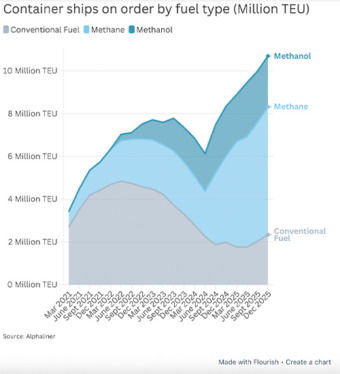
Future fuel demand is being led by methanol and methane dual-fuel container ship orders, with 78 percent of container ship orders by Twenty-foot Equivalent Unit (TEU) being dual-fuel.
TEU measures the capacity that will move global trade and, according to WSC, is an indication of future fuel demand for container ships.