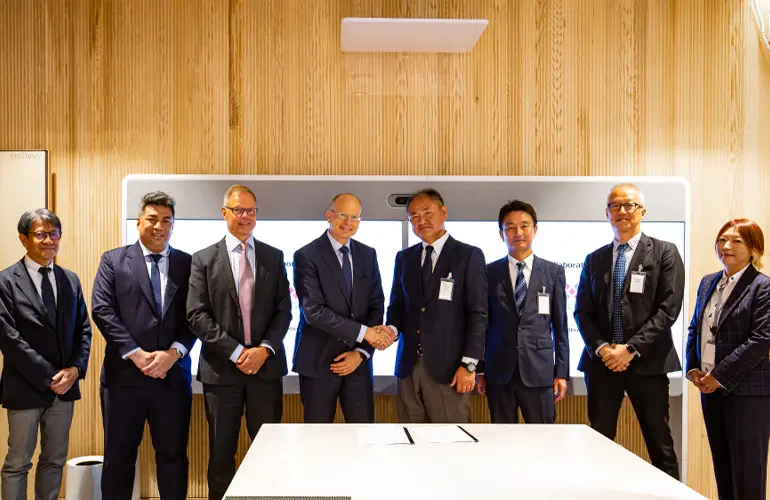
Finnish international technology group Wärtsilä Oyj has announced that it and Tokyo Gas Engineering Solutions Co., Ltd (TGES) have signed a Memorandum of Understanding (MoU) to jointly evaluate power supply solutions for data centres in Japan. The MoU was signed in Helsinki, Finland in August 2026.
Driven by the rapid growth of AI and cloud computing, demand for new data centre capacity is accelerating in Japan.
At the same time, grid connection constraints and lengthy power procurement timelines are creating challenges for developers seeking to bring new facilities online quickly.
These trends are increasing interest in on-site and off-grid power solutions that can provide reliable electricity where and when it is needed.
The MoU between Wärtsilä and TGES aims to establish a framework for jointly evaluating gas- or dual-fuel engine-based power generation solutions for selected data centre opportunities under development by TGES in Japan.
Under the MoU, the two companies will cooperate in developing initial technical concepts and establishing performance parameters, and in assessing the feasibility of selected projects.
This collaboration will leverage TGES’s local market and project-development expertise alongside Wärtsilä’s experience in data centre power plant concepts.
As AI adoption accelerates, delivering reliable power quickly is becoming a critical factor in enabling new data centre development. Wärtsilä has an evolving role in Japan’s energy market, and this collaboration with TGES will support both parties’ ability to meet the technical requirements and scope for powering data centre projects. By combining our respective strengths, we can evaluate solutions that provide the flexibility, scalability and speed required to support Japan’s growing digital infrastructure needs, said Anders Lindberg, President of Wärtsilä Energy and EVP of Wärtsilä.
Wärtsilä is a proven provider of on-site power to data centre projects. Wärtsilä engines deliver continuous, reliable primary power and use significantly less water and fuel than traditional alternatives, such as gas turbines.
Their rapid ramp-up capability also provides dependable power availability, which is vital for AI and cloud operators. The engines’ modular design enables easy scalability as power demand grows.