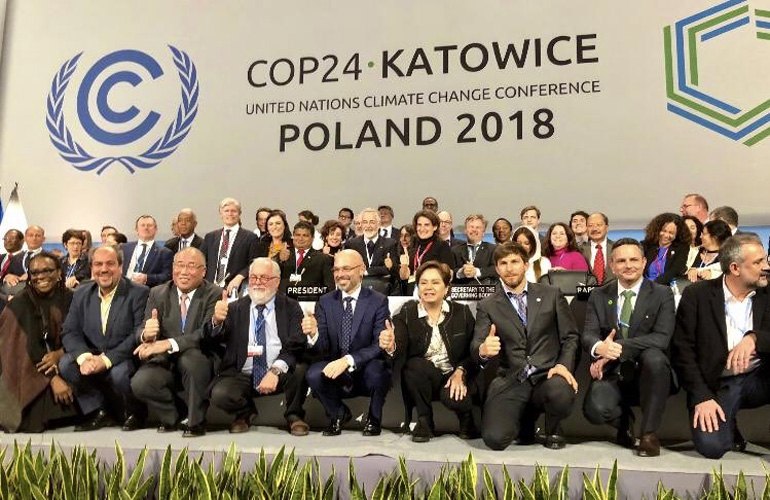
The UN climate conference (COP24) in Katowice, Poland, concluded with the adoption of a clear rulebook to make the Paris Agreement on climate change work in practice globally."The EU played an instrumental role in reaching this outcome, working with allies from both developed and developing countries and with major economies, in particular, China, to raise ambition and strengthen global efforts to fight climate change," said Commissioner for Climate Action and Energy Miguel Arias Cañete.
The completion of the Paris rulebook was the EU’s top objective in these negotiations and will enable the Parties to the Paris Agreement to implement, track and progressively enhance their contributions to tackling climate change, in order to meet the Agreement’s long-term goals.
In Europe, and working united as Europeans, we have reached a balanced deal on the rules to turn the Paris Agreement into action. The EU played an instrumental role in reaching this outcome, working with allies from both developed and developing countries and with major economies, in particular, China, to raise ambition and strengthen global efforts to fight climate change, said Commissioner for Climate Action and Energy Miguel Arias Cañete.
EU action
The EU’s nationally determined contribution (NDC) under the Paris Agreement is to reduce greenhouse gas (GHG) emissions by at least 40 percent by 2030 compared to 1990, under its wider 2030 climate and energy framework.
All key legislation for implementing the 2030 emissions target has already been adopted, including the increased EU’s 2030 targets on renewable energy and energy efficiency – which if fully implemented could lead to an EU GHG emissions cut of some 45 percent by 2030, the Commission has estimated – as well as the modernisation of the EU Emissions Trading System (ETS) and 2030 targets for all Member States to cut emissions in sectors such as transport, buildings, agriculture and waste.
In November 2016 – just before the Paris Agreement entered into force – the Commission presented the “Clean Energy for All Europeans Package“, aimed at setting the most advanced regulatory framework that will make the European energy sector more secure, more market-oriented and more sustainable.
The Commissions says that it acknowledges that this transition is going to be more difficult for some regions than others – notably those regions, where the economy is based on coal production. Together with these legislative proposals, it has outlined a special initiative to work with coal and carbon-intensive regions in transition so that they can also benefit from the clean energy transition.
EU ambition also goes beyond 2030. Following the invitation by the EU leaders, the Commission on November 28 presented its “Clean Plant for All”, a strategic long-term vision for a prosperous, modern, competitive and climate-neutral European economy by 2050.
The strategic vision, which follows wide stakeholder consultation and takes into account the recent IPCC special report on 1.5°C, is an ambitious vision for ensuring a prosperous, modern, competitive and secure economy, providing sustainable growth and jobs and improving the quality of life of EU citizens.
The strategic vision, which the Commission presented to global partners at COP24, will kick-start an EU-wide debate which should allow the EU to adopt a long-term strategy and submit it to the UNFCCC by 2020. To this end, the European Council invites the Council to work on the elements outlined in the Communication.
The EU also remains committed to the collective global goal to mobilise US$100 billion a year by 2020 and through to 2025 to finance climate action in developing countries, from a variety of public and private sources. In 2017, the EU, its Member States, and the European Investment Bank (EIB) together provided a total EUR 20.4 billion in climate finance, around a 50 percent increase from 2012.
Key COP24 outcomes
The Paris Agreement rulebook contains detailed rules and guidelines for implementing the landmark global accord adopted in 2015, covering all key areas including transparency, finance, mitigation, and adaptation. Key COP24 outcomes include:
- The first ever universal system for the Parties to track and report progress in climate action, which provides flexibilities to those countries that genuinely need it. This will inspire all Parties to improve their practices over time and communicate the progress made in clear and comparable terms.
- A good, consensual outcome on adaptation issues. The Parties now have guidance and a registry to communicate their actions as regards to adapting to the impacts of climate change.
- As to the global stocktake process, the next moment to review collective action, which the EU considered vital for the Paris Agreement, the result provides a solid basis for further elaboration on the details of the process. The global stocktake will invite Parties to regularly review progress and the level of ambition based on the latest available science.
- Finally, with the decisions on finance and technology, there is now a solid package that the EU trusts will provide reassurances to our partners on our commitment to continued global solidarity and support.
We have responded to the urgency of science by acknowledging positively the IPCC special report on global warming of 1.5°C. This was a key ask for the EU and its allies. The Paris rulebook is fundamental for enabling and encouraging climate action at all levels worldwide – and success here also means success for multilateralism and the rules-based global order. The EU will continue to lead by turning our commitments into concrete action, leaving no-one behind in the transition to a climate-neutral future; and inspiring other countries to make this necessary transition. I would like to thank Minister Kurtyka and the Polish COP Presidency for a job well done, and to Minister Köstingerand her team from the Austrian Presidency for helping the EU stay united and leading, said Commissioner Miguel Arias Cañete.