Swedish fuel cell technology developer PowerCell Group (PowerCell) has announced the launch of the first products in its new Power Generation portfolio, a dedicated, industrialised product family designed to support the growing need for reliable, zero-emission power in data centers, distributed energy, backup power and other mission-critical applications.
According to a statement, this is the broadest product introduction in PowerCell’s history and marks the start of a stepwise rollout of systems and modules purpose-built for power-generation duty cycles.
Over the past years, we have built strong positions in marine and aviation through careful product discipline and system design. With this portfolio, we are applying the same approach to Power Generation. We have taken the time to understand customer needs, validate the architecture, and ensure that we launch products that are industrial, cost-competitive, and ready for real-world deployment, says Richard Berkling, CEO of PowerCell Group.
Scalable portfolio for power generation
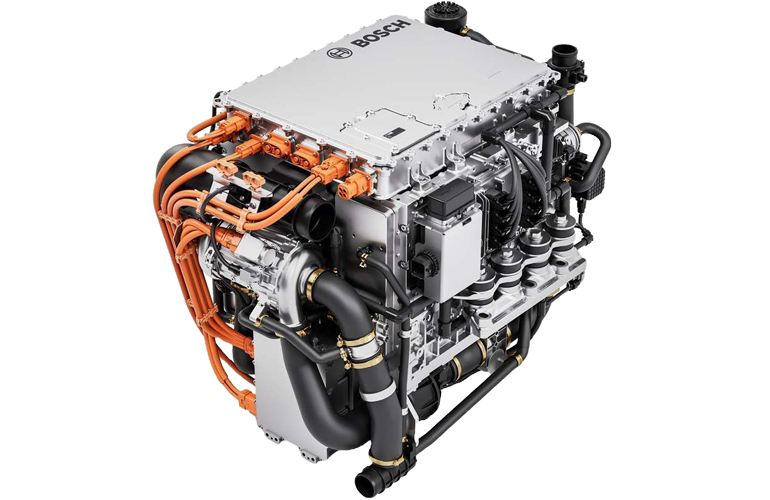
The new portfolio brings together Bosch’s industrial fuel cell foundation with PowerCell’s application expertise and system integration capability.
It integrates the fuel cell solutions with the PowerCell Distributed Master Controller (DMC), providing a unified control architecture, high efficiency, robust performance, and seamless connectivity.
Combining Bosch’s scale and manufacturing stability with PowerCell’s experience from marine, aviation, and complex multi-unit architectures, the portfolio is optimised specifically for the Power Generation segment.
The result is two distinct platforms built on joint experience, joint volume, and complementary strengths: PowerSystem and PowerPod solutions, respectively.
PowerSystem Solutions
The PowerSystem solutions are designed for OEMs and EPCs. These are fuel cell systems offered as standalone solutions or building blocks for integrators designing containerised systems, power rooms, or larger high-efficiency sites.
These include PowerSystem 190, PowerSystem 225 (low-pressure and liquid hydrogen capable), M2PowerSystem 250 (integrated methanol-to-power solution)
and are designed for clients who want design flexibility while relying on industrialised hydrogen modules.
PowerPod Solutions
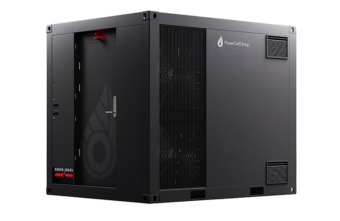
The PowerPod solutions are containerised plug-and-play systems. These are fully integrated, ready-to-deploy systems for end-users who require dependable, transportable, or rapidly deployable zero-emission power.
PowerPods are engineered for distributed power, backup power, mobile or temporary power, mission-critical, and off-grid applications.
The containerised format allows fast installation, minimal civil works, and predictable performance, complementing or replacing traditional combustion-based gensets with a zero-emission alternative.
DMC software and control architecture
The entire Power Generation portfolio is built around PowerCell’s Distributed Master Controller (DMC), the software and control architecture that coordinates and optimises multiple fuel cell units as one integrated system with seamless connectivity.
Drawing on PowerCell’s long experience with complex multi-unit configurations in marine and aviation, the DMC lowers the total cost of ownership through:
- higher uptime through intelligent load balancing;
- improved durability and efficiency by optimising operating points;
- stable performance under dynamic and mission-critical conditions
This system-level capability is particularly relevant for distributed power, data centers, and other applications where power quality, resiliency, and operational continuity are essential.
Designed for a market entering a new phase
According to PowerCell, hydrogen will increasingly complement existing power solutions in segments where grid access is limited or constrained; where power demand grows faster than infrastructure; where longer-duration, low-emission backup is required, and/or when resilience and uptime are critical.
PowerCell’s portfolio has been shaped to address these early market movements with standardised, modular, and ready-to-scale systems.
This launch reflects a clear direction: products that are built for real-world duty cycles, validated through experience, and designed to integrate into the energy systems of the future. We will expand the portfolio step by step, guided by customer needs and where PowerCell can deliver sustainable value, concluded Richard Berkling.