
The success of Europe’s energy transition depends on balancing affordability, security, and sustainability. Fossil gas, renewable- and low-carbon gases are uniquely positioned to deliver this and help ensure Europe has an energy system fit to support its competitiveness according to a new report commissioned by Eurogas, an association representing gaseous energy in Europe.
Conducted by Frontier Economics Ltd, the report “Ensuring Resilience in the European Energy Transition: Strategic Use of Gases to Meet EU Climate Ambitions” finds that gases can support the energy system’s affordability, security, and sustainability.
The findings demonstrate the importance of fossil gas, renewable- and low-carbon gases in delivering Europe’s net zero energy transition by 2050. Working alongside increasing electrification, gases can help ensure the energy system is fit to support industrial competitiveness and protected from geopolitical risk.
Gases will remain crucial
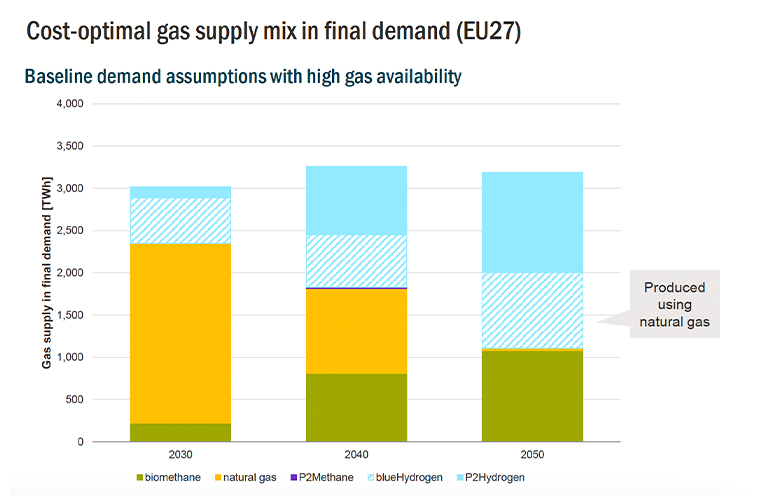
Contrary to the common framing of gas as merely a transition fuel, the report shows that by 2050 gases will remain crucial in final energy demand.
Hydrogen and its derivatives may emerge as the second-largest energy carrier, with biomethane aka renewable natural gas (RNG) gradually replacing fossil gas in final energy consumption.
Gases will be even more crucial if deviations from desired transition pathways occur the report finds, as gases build the resilience of Europe’s energy system. This is already being tested today, as geopolitical turbulence is impacting prices across the EU.
Call for action
Based on the report findings Eurogas urges European leaders to act now to deliver essential gases on time. This means focusing investment and policies on rapidly phasing in renewable and low-carbon gases and using existing infrastructure.
Many of these gas-based solutions can be delivered domestically, reducing reliance on imports.
A successful energy transition in Europe relies on striking the right balance between affordability, security, and sustainability – a balance that gases are uniquely positioned to achieve. Natural gas, renewable and low-carbon gases are essential to a resilient energy system that not only safeguards Europe’s industrial competitiveness and stabilizes energy prices, but also provides the flexibility needed to adapt to evolving circumstances as we move towards net zero, commented Andreas Guth, Secretary General of Eurogas.
The report finds that gases can support the energy system’s:
- Affordability: Gases enable a cost-efficient energy transition process, including repurposing existing infrastructure. Long-term, gases can help to lower energy prices for industry and consumers: increased availability of renewable gases is projected to lower average electricity prices by between 5 and 21 percent. In 2030 and 2040, hydrogen prices could be nearly 30 percent lower with greater availability of gases.
- Security: Gas and hydrogen-fired power plants are crucial for maintaining energy security, especially as the share of intermittent renewable electricity and the electrification of final demand increases.
- Sustainability: Gases are a key enabler for the EU to meet its decarbonization objectives. Even in high electrification scenarios, gases continue to play a major role in final energy demand in 2050: the share of gases in final demand still increases, and hydrogen and its derivatives emerge as the second largest energy carrier.
Based on the report, Eurogas makes the following recommendations to EU leaders:
- Maximize the potential of biomethane, a “must-have” option to serve the remaining methane demand. It is also the most viable and cost-effective option to deliver necessary negative emissions;
- Build a value chain for hydrogen and its derivatives, to enable them as a key energy carrier in the long term. The report projections show that green hydrogen starts to exponentially grow only after 2040, once existing renewable energy targets have been met. Until then, low-carbon hydrogen is essential to scale the hydrogen value chain;
- Enable Carbon Capture and Storage (CCS). This is not optional: it’s a necessity for achieving sustainability and energy security objectives in Europe. CCS can uniquely support the decarbonization of methane and hydrogen demand, and enable cost-effective negative emissions when combined with biomethane;
- Repurpose existing gas infrastructure for renewable and low-carbon gases. Gas and hydrogen infrastructure remains the backbone of the European energy system. This role becomes even more important in case real-world developments deviate from desired transition pathways;
- Leverage domestic natural gas and biomethane resources, as recommended by REPowerEU and the Draghi Report. This improves the security of supply by lowering dependence on imports, affordability by reducing exposure to geopolitical risks, and sustainability by lowering the lifecycle emissions.