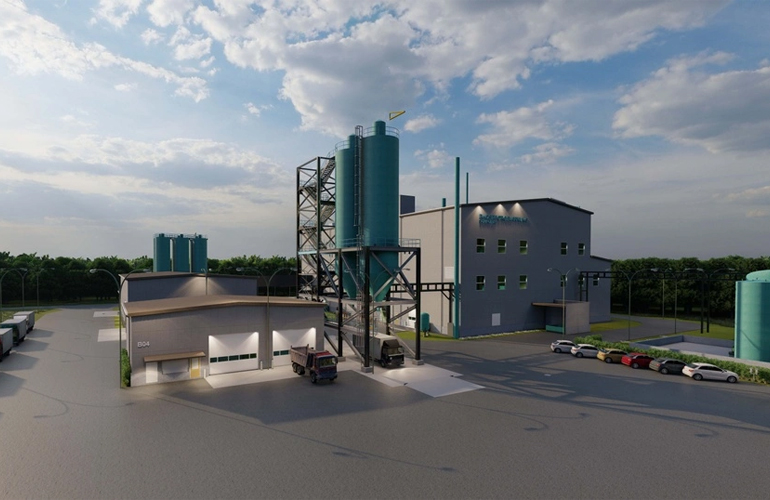
In Germany, EasyMining Germany and GELSENWASSER AG, through their joint venture Phosphorgewinnung Schkopau GmbH (PGS), have announced that PGS has received the green light from authorities to establish a phosphorus recovery plant based on the Ash2Phos technology in Schkopau.
The new phosphorous recovery facility in Schkopau will utilise the proprietary Ash2Phos technology, developed by the Swedish innovation company EasyMining, part of the Ragn-Sells Group.
The Ash2Phos process can transform sewage sludge ash (SSA), a residue from sewage sludge incineration, into a raw material for phosphorus extraction and thereby be a part of a circular solution for phosphorus management.
The process consists of three steps: first, an acidic step, a second alkaline step (where intermediate products are produced), and a final conversion step where the intermediates are processed into final products.
Through this technology, over 90 percent of phosphorus contained in the SSA can be extracted.
Getting the permit is a big and important step closer to the first Ash2Phos-plant, which is expected to start production in 2027.
The State Administrative Office positive statement presents a golden chance for us to establish a circular solution for the vital nutrient phosphorus. We eagerly look forward to initiating the phosphorus recovery process, which will not only secure a stable supply of high-quality phosphorus within Europe but also contribute to a more sustainable food supply, said Christian Kabbe, CEO at EasyMining Germany and PGS.
In addition to the benefits for phosphorus supply, the Schkopau project will have significantly positive impacts on environmental protection and waste management in Germany.
The positive permit from the State Administrative Office gives us the opportunity to finally start processing waste from municipal wastewater treatment and to strengthen water and soil protection in Germany. Phosphorus recovery is key to making urban water management waste-free and reintegrating these valuable materials back into the economic cycle, said Martin Braunersreuther, Head of Sales – Industry Services at GELSENWASSER.
Compliance with German Sewage Sludge Ordinance
As an energy and water infrastructure company, GELSENWASSER is responsible for the entire water cycle in the Ruhr region.
Given the need to use resources efficiently, close cycles, and actively protect soil and water, GELSENWASSER launched the initiative ‘Sauberer Phosphor 2029’ (Clean Phosphorus Initiative 2029) together with EasyMining and other stakeholders and phosphorus recovery technology providers to promote phosphorus recovery from municipal sewage sludge.
The initiative is directly linked to the German Sewage Sludge Ordinance, which requires phosphorus recovery from sewage sludge starting in 2029.
The ‘Sauberer Phosphor 2029’ initiative is of great importance to us to draw attention to the issue and establish a more environmentally friendly and efficient method of phosphorus recovery, said Henning Pretis, responsible for Public Affairs and Strategy in the Sewage Sludge Department at GELSENWASSER.
Close the cycle and reduce import dependence
Phosphorus is a vital ingredient in fertilizers and an essential additive for livestock feed. However, its primary source in Europe is derived from imported phosphate rock, a non-renewable resource.
New processes to recover phosphorus from incinerated sewage sludge are being developed and implemented into large-scale operations.
Sewage sludge ash (SSA) is not only a potential circular source of phosphorus but also a domestic one.
If we are serious about building a sustainable society, we must utilise the resources we already have. In the Ash2Phos-plant we will not only extract and recover phosphorus but also other products such as ferric chloride and sodium aluminate. All as commercial products important for the society, ended Christian Kabbe.