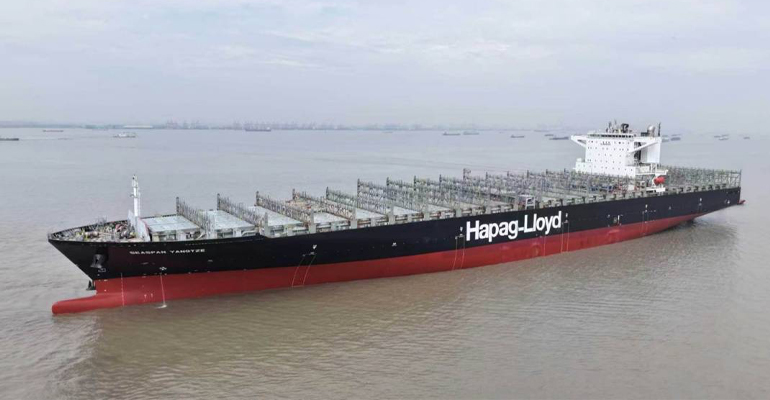
Germany-headed global container liner major Hapag-Lloyd AG, and Canada-headed Seaspan Corporation, a global leader in maritime asset ownership and management, have announced the completion of the first conversion under their joint methanol retrofit program. With the delivery of the “Seaspan Yangtze”, the first of five 10,100 TEU charter vessels, upgraded from a conventional MAN S90 engine to a dual-fuel engine capable of running on methanol.
The conversion of Seaspan Yangtze marks an important milestone in the strategic collaboration between Hapag-Lloyd, Seaspan Corporation, and Everllence.
The program also covers “Seaspan Amazon”, “Seaspan Ganges”, “Seaspan Thames” and “Seaspan Zambezi”. The overall investment for the five retrofits is estimated at around US$120 million.
Retrofitting existing vessels is an important lever on our way to decarbonize our fleet operations by 2045. The successful conversion of the Seaspan Yangtze shows that technical innovation and close cooperation with strong partners can make proven vessels ready for the use of low-carbon fuels. For our customers, this is another concrete step towards more sustainable supply chains, said Silke Lehmköster, Managing Director Fleet at Hapag-Lloyd.
Each conversion can reduce carbon dioxide equivalent (CO2eq) emissions by approximately 30,000 to 50,000 tonnes per vessel per year when operating on low-carbon methanol.
In addition to supporting emissions reductions, the project extends the operational use of existing vessels and increases fuel flexibility.
Hapag-Lloyd is pursuing its sustainability strategy through several levers, including newbuildings, dual-fuel retrofits, efficiency improvements in the existing fleet and the sourcing of alternative fuels.
The conversion of Seaspan Yangtze demonstrates the role that existing ships can play in the transition towards low-carbon shipping.