In Finland, methane pyrolysis process developer Hycamite TCD Technologies Oy (Hycamite) has announced the launch of graphite production with a very low carbon footprint. Hycamite’s novel methane-splitting technology delivers low-carbon hydrogen and high-quality carbon products on an industrial scale.
Thanks to advances in proprietary catalysts and process technology, Hycamite says that it can now offer graphite with a very low carbon footprint compared to conventionally produced synthetic graphite.
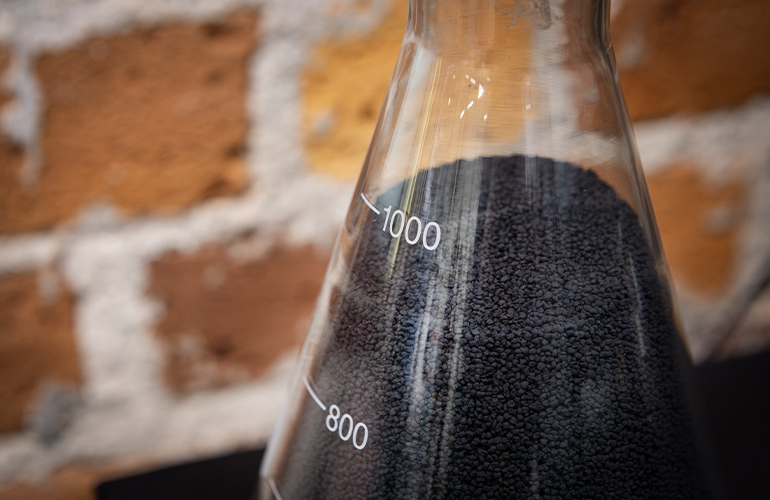
Hycamite’s graphite can be used in electric vehicle batteries. It’s suitable for direct use or further refinement based on the individual battery manufacturer’s needs, said Niina Grönqvist, Hycamite’s VP of carbon products.
(Bio)methane decomposition
Hycamite’s technology helps decarbonize industries by providing low-carbon (turquoise) hydrogen and sustainable carbon products for demanding industrial applications.
Hycamite’s technology decomposes large volumes of methane into its component elements – hydrogen and carbon – while avoiding the release of greenhouse gases (GHGs) into the atmosphere.
Furthermore, Hycamite’s catalysts are sustainable as they are recyclable and can be produced from industrial side streams.
According to a life cycle assessment (LCA), using Hycamite’s carbon products can significantly lower GHG emissions when producing numerous carbon-containing products.
The results showed Hycamite’s carbon footprint to be below 1 kg CO2e/kg C for Hycamite’s carbon as it comes out from the reactor.
While the Hycamite carbon LCA was focused on the climate change impact, there are also other negative environmental impacts when producing graphite with current methods.
For instance, synthetic graphite production can seriously damage the environment without significant protection investments. Manufacturing emits nitrogen dioxide, sulfur dioxide, and particulates from baking the hydrocarbon feedstocks, said Niina Grönqvist.
Other high-value carbon products are electrically conductive, making them ideal for supercapacitors, electronics, electric cables, additives in polymers and even building elements made with composite materials or concrete.
By using the range of its catalyst families and changing process parameters, Hycamite can tailor its high-value carbon products to customer needs and produce them industrially in very large quantities.
Customer Sample Facility
Hycamite is currently building its new Customer Sample Facility (CSF) in Kokkola, Finland. The facility is intended to demonstrate the viability of Hycamite’s new methane-splitting technology, and it will be the largest methane pyrolysis facility in Europe.
CSF’s nominal capacity will reach 2,000 tonnes of hydrogen and 6,000 tonnes of high-quality carbon per annum once the project is fully completed.
The decarbonization capacity of CSF can be up to 18,000 tonnes of carbon dioxide (CO2) per year when liquefied natural gas (LNG) is used, and with biomethane (aka renewable natural gas – RNG), carbon removals can be achieved.