
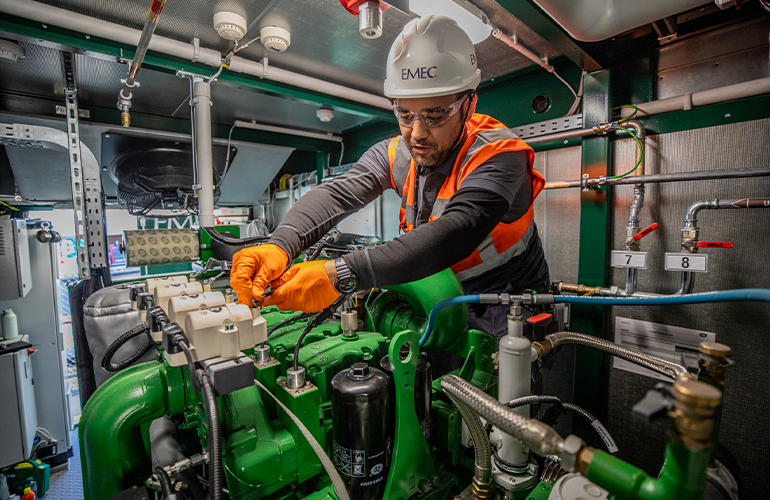
A novel hydrogen combustion engine technology trial, led by European Marine Energy Centre Ltd (EMEC) at Kirkwall Airport (KOI) in Orkney, was completed earlier this month. This marks the first time hydrogen has been used to meet both the power and heat demands of a commercial airport in the UK.
Funded by the Scottish Government via Highlands and Islands Enterprise and supported by work through the Sustainable Aviation Test Environment (SATE) and Rural Energy Hubs projects, the trial brought together representatives from EMEC and 2G, with support from Highlands and Islands Airports Ltd (HIAL), which manages and operates Kirkwall Airport (KOL).
This project was initially driven by an energy consumption study delivered by EMEC through the ReFLEX Orkney project, which identified key opportunities to decarbonise airport operations. Orkney is well established as a hub for energy innovation, where new technologies and their roles in delivering a future clean energy system are demonstrated, said Leonore Van Velzen, Operations and Maintenance Manager at EMEC.
Green hydrogen heat and power
Manufactured by 2G Energy AG, the system was the first 100 percent hydrogen combined heat and power (CHP) unit of its kind to be installed in the UK.
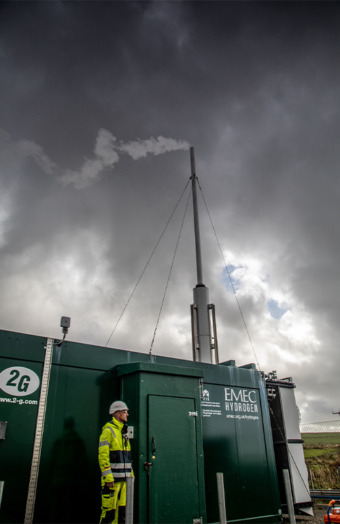
It was positioned airside at Kirkwall Airport and subsequently coupled with the airport’s existing heating system to supply heat to the main terminal building and power across the entire site.
The CHP system used green hydrogen, supplied by EMEC, to generate electricity and recover by-product heat.
Working with airport ground staff, additional electrical loads were activated to test the system, allowing the CHP to supply a steady output.
System performance and integration were monitored while the CHP system operated at approximately 60 percent capacity.
During the trial, the CHP powered the airport terminal and runway lighting, meeting the heating demand without requiring the airport’s boilers to operate.
With over 10,000 CHP systems installed worldwide across a range of gas types, bringing our hydrogen CHP technology to Kirkwall Airport marks a significant milestone for 2G in the UK. Demonstrating how hydrogen can reliably deliver both power and heat in such a critical infrastructure setting is an important step towards decarbonising energy-intensive operations. This project showcases what’s possible when innovation and collaboration come together, and we’re proud to see 2G’s technology contributing to Scotland’s leadership in the transition to net-zero aviation, said Mark Holtmann, Managing Director at 2G.
The completion of this trial marks a step toward assessing the real-world feasibility of integrating hydrogen technologies with airport infrastructure.
The insights gained will contribute to wider efforts to explore low-carbon solutions across aviation and other sectors.
This trial is a great example of collaboration in action, combining EMEC’s hydrogen expertise, the technical capabilities of 2G, and the operational insight of HIAL’s airport team, specifically the airport fire service. Seeing hydrogen deployed in a live airport environment is a significant step forward in exploring practical decarbonisation solutions, and we’re proud to have supported the safe delivery of this first-of-its-kind demonstration, concluded Leonore Van Velzen.