
Much has and can be said about the exceptionally dramatic, even traumatic (European) 2022/2023 pellet heating season that at the time of print is pretty much over. The recent political agreement reached on the third revision of the Renewable Energy Directive (REDIII), arguably one of the most important pieces of EU legislation when it comes to bioenergy, rejected the non-sensical and detrimental “primary woody biomass” notion.
It is an important step in the right direction and while providing some respite, the battle of public perception is far from over. Australia is a recent case in point as native forest biomass is no longer an ‘eligible renewable energy source’ for the purposes of the Renewable Energy Target (RET).
On the plus side from a user perspective is that pellet prices per MWh would seem to be on a downward trend in Northern Europe, at least according to Baltpool’s latest index over the last twelve months. Gilles Gauthier from Hawkins Wright (previously Bioenergy Europe/European Pellet Council) offers a global analysis and commentary for industrial pellets while Tim Portz from Pellet Fuels Institute (PFI) provides a review of the US heating season.
While some PFI member volumes appeared on the European residential market, Xinyi Shen gives an insight into the pellet world’s “elephant in the room” by reporting on China’s first ENplus-certified pellet producer. China’s first ENplus-certified pellet producer is a 300 000 tonnes-per-annum facility currently exporting to Europe and has a second 500 kt facility on the drawing board. Just recently, a second Chinese producer has been certified.
Furthermore, a possible easing of China’s pellet import restrictions is, apparently, on the table. If so, and depending on how this possible easing is implemented, it could have seismic implications on pellet trade flows- and pricing in years ahead.
As mentioned in Bioenergy International No. 1/2023, there are pellet industry pioneers and trailblazers that have found themselves chartering unknown waters, more oft than not by necessity rather than design. Either way, they deserve recognition or acknowledgment for their achievement(s) that enable others to follow or develop further.
There are numerous persons in countries around the world that have pushed or are pushing the envelope for the development of the biomass pellet industry. Sweden’s unassuming and affable “Mr. Pellets” is one such person who features in the Forssjö Pellets story, a decade as part of Sandåsa Timber.
For full disclosure purposes, I am, via a local third-party retailer, a longstanding user of their pellets. Since 2006 in fact which is well before my current position. And, for two reasons. Firstly, the facility is geographically the closest pellet producer to where I live and heat my home, and secondly, the retailer is my local sawmill which is also an occasional supplier of sawdust to the pellet plant. Given that pellets are standardized, it is my small but deliberate contribution to the local circular bioeconomy.

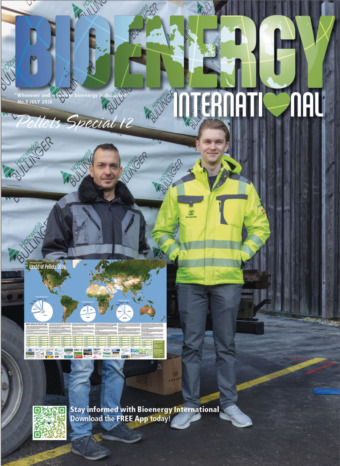
Others examples I happen across on various “industrial tourism” escapades. I dare say that not many have had a tour of a dryer installation – from the inside that is, and with full upright mobility. The front cover shows what a DryerOne looked like in late November 2022 as it was being installed at an integrated sawmill- and pellet plant in Belgium.
And on the topic of biomass drying, another “lesser-known” technology is (finally) out of the bag – Saalasti’s mechanical dewatering “Hippo” that reduces free water from raw woodchips or sawdust upstream of the dryer. No surprise that it is Germany’s van Roje that volunteered disclosure – being unconventional is conventional for van Roje, and that is meant as a complement.
In the Land of Fire and Ice, not only was “ilmur” discovered but a whole market value ecosystem that is evolving as fast as the weather changes – history in the making – thanks to a pair of seasoned entrepreneurs behind Tandrabretti. It is also an example of how biomass pellets can help stimulate afforestation by providing a market outlet for first thinnings displacing imported heating oil in the process.
Not that Iceland is predestined to become the next Vietnam of production or Japan of consumption any time soon. According to Skógræktin, the Icelandic Forest Service, up to 40 000 km2 or 38 percent of the land area is potentially suitable for afforestation. However, for various reasons, the afforestation rate has been low, only 1 000 – 1 500 ha per year. Thus, it would take around 70 years to reach another 1 percent of land under forest cover. Nonetheless, it is an intriguing case to follow as it offers inspiration to others looking to develop a local circular bioeconomy in which pellets are the key enabler.
One such example is found in India, in the clean cooking space. Aptly called Ecosense, the company is developing the village-scale biomass pellet for the cooking value chain by developing and manufacturing both the pelleting technology and cookstoves.
The aim is to enable villages in rural areas outside the reach of bottled LPG to produce their own cooking fuel from locally available residues. Finally, Michael Shepard wraps up this issue with a thought-provoking piece on how these two worlds – industrial wood pellets and gasifier cookstoves – could meet to bring affordable clean biomass pellet cooking at scale.
Now that is pellet ilmur – the fragrance of life.