Sweden-based Löfbergs Lila AB, one of the largest coffee roasters in the Nordic region, has taken a major step in reducing its climate impact. By incorporating a 20 percent blend of bio-LPG into the LPG fuel used at its coffee roasting facility in Karlstad, the company says it will achieve its goal of reducing its climate impact by at least 40 percent by 2020 compared to 2005.
Every day, Löfberg’s coffee roasting facility in Karlstad, Sweden receives 140 tonnes of raw coffee, and every day more than ten million cups leave the facility. The roasting process has long been a major sustainability challenge and the fourth generation family-owned company has been working actively to find alternatives to conventional liquefied petroleum gas (LPG), which is a fossil fuel.
Now by incorporating bio-LPG, Löfbergs will achieve its goal of reducing its climate impact by at least 40 percent by 2020.
– A milestone that shows how important it is to set concrete goals for its sustainability work. When we set the goal, we did not really know how to achieve it, but it made us focus on the task, which gave results, said Eva Eriksson, Sustainability Director at Löfbergs.
A greener alternative
As members of the Swedish corporate network Haga Initiative, Löfberg’s goal is to reduce its climate impact by at least 40 percent by 2020 compared to the base year 2005. The biggest climate impact of the operation is from the LPG used in the coffee roaster, and a prerequisite for achieving climate goals has been to find a greener fuel alternative.
The solution was thus to incorporate bio-LPG supplied by Kosan Gas, one of the Nordic region’s leading gas product suppliers.
– The bio-LPG is extracted from sustainable raw materials such as vegetable oils and animal fats in the production of biodiesel. By mixing 20 percent bio-LPG, our carbon dioxide (CO2) emissions are reduced by 19 percent, which means that we reach our overall goal, said Eva Eriksson.
Responsibility from bean to cup
According to the company, much of its environmental and sustainability work takes place in the grower countries where coffee bean sustainability challenges are the greatest and account for about 80 percent of the total environmental and climate impact of coffee.
Efforts include providing small-scale coffee growers with the tools to meet climate change and improve their living conditions as well as ensuring that the next generation sees a future as coffee growers. In Sweden, sustainability work is about energy efficiency, smarter transport, more renewable energy and climate-smart packaging.
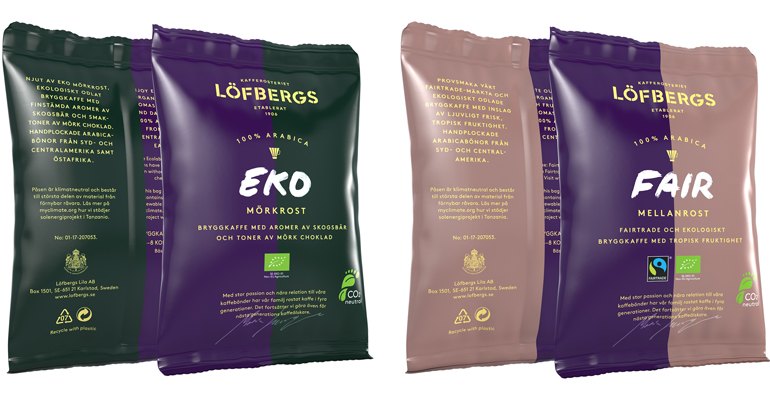
For the latter, the company began testing with biobased plastic in August 2017. The sugarcane-derived packaging reduces fossil carbon dioxide (CO2) emissions by about ten percent. It is recyclable and has the same protective properties as conventional oil-based plastic, which is important because coffee is sensitive to light and oxygen.
If the trials prove successful the company hopes to phase out all fossil plastic in packaging by 2020.