Plans to build Denmark's first integrated biorefinery in Maabjerg near Holstebro on Jutland have been shelved. Lack of political support and failure to secure municipal loan guarantees were cited as the reason for the decision.
– It’s a great shame that we’re now forced to make the tough decision to drop the project. We have an extremely well-designed project, which has been scrutinised from all angles over five years. Now other countries will be driving the development and creating jobs, while Denmark might have to import its ethanol instead, said Jørgen Udby, Chairman of the Board for Maabjerg Energy Center (MEC).

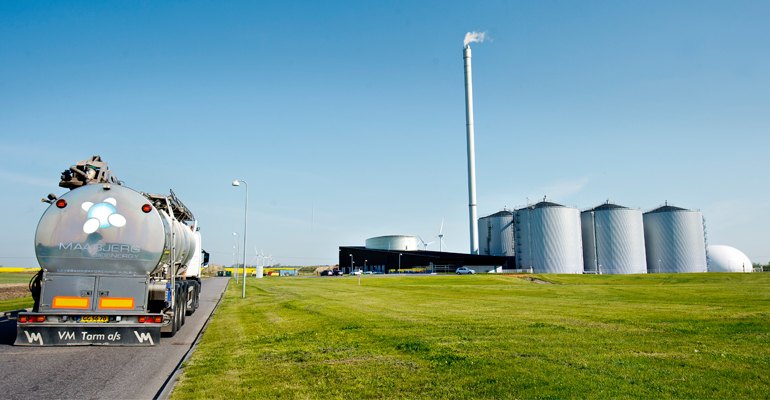
The plan was to build and integrate a second-generation ethanol plant, MEC Bioethanol, with the existing energy facilities at the site, MEC BioHeat & Power, and MEC Biogas. The former is a 28 MWth municipal solid waste (MSW), biomass and biogas-fired combined heat and power (CHP) plant, originally commissioned in 1993 to supply heat to the towns of Holstebro and Struer.
The latter was commissioned in June 2012 and is one of Europe’s largest industrial biogas plants with a capacity to treat up to around 800 000 tonnes of material per annum and produce ≈21 million Nm3 biogas. The feedstock is predominately slurry and animal manure (≈ 500 000 tonnes) but also includes whey from a cheese factory, sewage sludge, and potato residues from a processing plant.
Straw based
The 70 million litre per annum capacity large-scale demonstration facility was to be the final component of the MEC complex and the plan was to utilize up to 400 000 tonnes per annum of straw as the feedstock. In the summer of 2014, MEC was awarded DKK 293 million in EU funding and the MEC consortium recently decided to double its own contribution to the project to a total of DKK 460 million. In May earlier this year, the Danish Government presented plans for a blending requirement for second-generation ethanol in transportation fuels. However, there has been a lack of political support to advance the project to the final step.
– We needed a green light from politicians to get the final component of the financing in place, including loans with municipal guarantees. Without loan guarantees, the project is no longer financially viable. So Denmark has to wave goodbye to DKK 293 million from the EU, but worst of all, it means losing 1,000 permanent jobs and the possibility of Danish green technology exports, said Udby.
According to Udby, the project should be viewed as a local project, which could create growth and jobs, and be a platform for advanced bio-economics in Denmark, leading to national benefits in terms of climate and resources and substantial export opportunities.
– In other countries, similar large-scale demonstration plants have received a helping hand in the form of cheap financing in order to be realized. It’s also the norm in Denmark for energy plants such as local CHP plants, biogas plants, district heating plants, waste plants and the like to be implemented using municipal loan guarantees, ended Jørgen Udby.