
In Sweden, MAN Cryo, the wholly owned subsidiary of Germany-headed MAN Energy Solutions SE, has – in close cooperation with Norwegian ferry operator Fjord1 ASA and vessel designer Multi Maritime AS – developed a marine fuel-gas system for liquefied hydrogen. The system has been granted preliminary Approval in Principle (AIP) by the DNV-GL Classification society. The award is significant in that the system is the first marine-system design globally to secure such an approval.
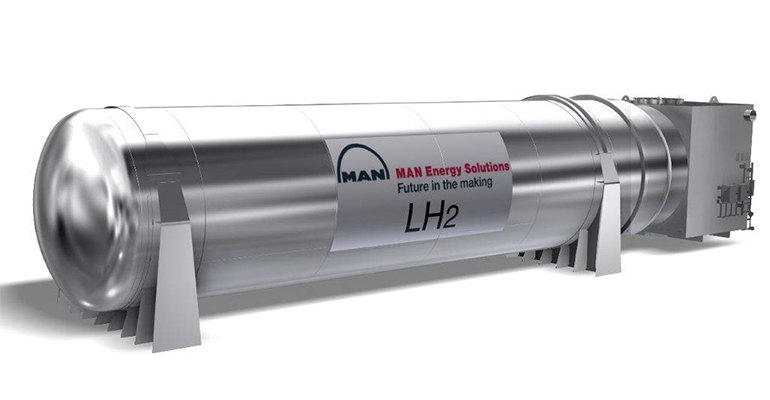
According to a statement, Multi Maritime’s hydrogen vessel design for Fjord1, including the fully integrated ‘MAN Cryo – Hydrogen Fuel Gas System’, has been granted preliminary Approval in Principle (AIP) by the DNV-GL Classification society.
Winning this approval is a significant development for a number of reasons. As a solution for vessels employed on relatively short maritime routes, such as ferries, this technology is a world-first and showcases our company’s ability to deliver genuinely innovative solutions. Furthermore, Hydrogen is a clean fuel whose profile fits perfectly with the general desire within the industry to move towards cleaner technology. The possibilities for this technology are varied and exciting, said Dr Uwe Lauber, CEO of MAN Energy Solutions.
MAN Cryo developed the Liquid Hydrogen Marine Fuel Gas System design in-house at its headquarters in Gothenburg, Sweden in close cooperation with the shipowner, Fjord1, and ship designer, Multi Maritime, in Norway.
To secure this approval in principle shows the determination that MAN Energy Solutions has to advance cleaner shipping solutions. Our strategy is to actively work with our customers to design and promote cleaner ways of powering vessels, and the competence and energy within MAN Cryo conveys this strategy excellently, said Louise Andersson, Head of MAN Cryo.
Fuel-gas system for liquefied hydrogen
The system has a scalable design that allows easy adaptation for different shipping types, sizes, and conditions. The design is suited for both above- and below-deck applications, offering ship designers the flexibility to optimise their designs in relation to efficiency, and to cargo or passenger space.
MAN Cryo has long experience with cryogenic gases and solutions for storage and distribution. The company has also made numerous hydrogen installations over the years on land that, in combination with its extensive experience from marine fuel-gas systems for liquefied natural gas (LNG), have been invaluable when designing the new system.
Liquefied hydrogen has a temperature of -253° Celsius and is one of the absolutely coldest cryogenic gases there is, which places system components and materials under extreme stresses. Another design challenge was hydrogen’s explosive nature, with the MAN Cryo engineering team accordingly placing top priority on safety.
Once liquefied, hydrogen is reduced to 1/800th of its volume, compared to that of its gas phase, facilitating a more-efficient distribution. As a fuel, hydrogen does not release any carbon dioxide (CO2) and can play an important role in the transition to a clean, low-carbon, energy system. Liquefied hydrogen can be used to charge batteries for electrical propulsion via fuel-cell technology.
MAN Cryo says that it sees a “bright future for hydrogen applications globally” as part of its target of achieving zero fossil emissions within the marine sector by 2050. In particular, Norway is currently developing several promising hydrogen applications.