
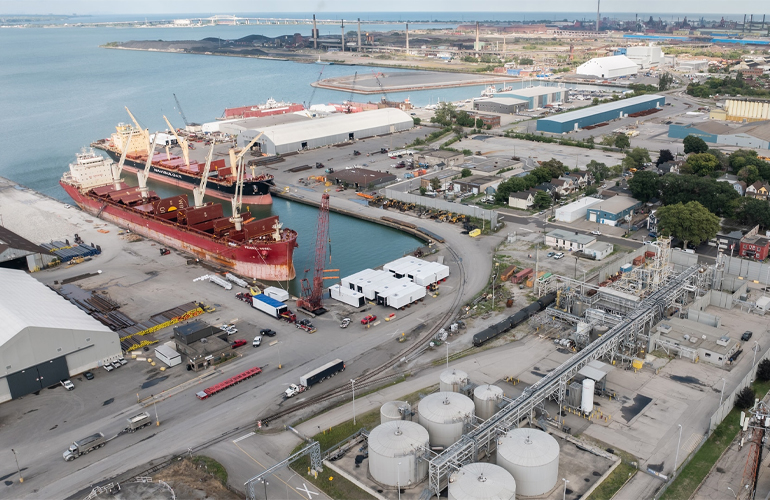
In Canada, HOPA Ports and the Mississaugas of the Credit Business Corporation (MCBC), the entity representing the business development interests of the Mississaugas of the Credit First Nation (MCFN), have partnered to save a critical biodiesel production facility in Ontario from permanent closure.
According to a statement, this effort is anchored by the development of a new Memorandum of Understanding (MoU) between HOPA Ports and MCFN, establishing a framework for ongoing partnership.
The project will be operated by Biidaaban Renewable Energy, a newly formed entity established to restart and operate the facility located at Pier 14 at the Port of Hamilton, Ontario.
MCBC has a 51 percent ownership position in the Biidaaban project, establishing a significant Indigenous-led investment in Ontario’s clean energy infrastructure.
This investment represents an important step toward reclaiming and advancing economic participation in sustainable energy by MCFN. Biidaaban, meaning ‘a new day’ and pronounced (bee-daw-bun), is an Anishinaabe term that means the point at which the light touches the earth at the break of dawn, and reflects both the renewal of this facility and our commitment to realizing a new dawn of economic reconciliation using a Treaty Forward Approach through long-term environmental stewardship, said Warren Sault, President and CEO of MCBC.
Favourable policy enables restart of operations
The restart of the Hamilton biodiesel facility comes amid improving conditions for Canada’s biofuels sector, following recent policy actions by both the Government of Ontario and the Government of Canada that have helped restore the economic viability of domestic biodiesel production.
In Ontario, regulatory changes to fuel blending requirements have strengthened demand for Canadian-produced biodiesel, helping stabilize the market and support local producers.
At the federal level, recent measures including enhanced support for domestic biofuel production and updates to clean fuel policies have been critical in addressing competitiveness challenges facing Canadian producers and improving market conditions for facilities like the Hamilton plant.
Biidaaban goes beyond simply bringing a proven asset back into operation with a strong, long-term ownership foundation. Rooted in Indigenous majority ownership, the right policy environment, and a team of experienced partners, Biidaaban is positioned to deliver reliable, low-carbon fuel solutions while creating over 70 jobs and multiple economic opportunities across the region, said Tim Haig, incoming President & CEO of Biidaaban Renewable Energy.
Path to restart
The direct participation of MCFN as the Treaty Rights Holder illustrates how the long-term benefits of embracing a Treaty Forward Approach positively impact the economic future of a sustainable Ontario and Canada.
Together, these forward-looking policy changes have created a more favourable operating environment, enabling new investment in clean fuels and supporting the restart of an idled biofuel infrastructure that will have significant impacts across the country.
Following a period of inactivity, the plant is now positioned for reactivation under new Indigenous-led ownership and operational leadership.
Biidaaban Renewable Energy has secured the necessary arrangements to assume operations of the facility, including a long-term lease for the lands, building, and plant assets, enabling a restart of biodiesel production.
The partners intend to restart operations later this summer, following final preparations and commissioning of the facility.
Strategic importance
The Hamilton biodiesel facility has long been recognized as a strategic asset for domestic fuel production, supporting Ontario’s energy security, emissions reduction goals, and economic resilience.
The Biidaaban facility is expected to reduce approximately 130,000 tonnes of carbon dioxide equivalent (CO2eq) emissions annually.
Before its shutdown by former US-based owners, the facility produced biodiesel from a mix of agricultural and waste-based feedstocks.
The restart of operations will help rebuild domestic production capacity, reduce reliance on imported fuels, and support Canadian agricultural producers and circular economic supply chains.
When market conditions shifted and the facility’s future became uncertain, the Hamilton biodiesel plant, the jobs, and economic activity it supported faced a period of real vulnerability.
As the owner of the lands, HOPA Ports stepped in to acquire the plant, stabilize and preserve the site, ensuring that this critical piece of energy infrastructure was not lost.
Through a period of market disruption, HOPA Ports supported and maintained the facility, bridging the gap until a viable path forward could be established.
HOPA’s objective has always been to protect this critical energy infrastructure and ensure it remains part of Canada’s energy future. By preserving the facility through a challenging period, we’ve been able to support a transition to new ownership that secures jobs, strengthens domestic production capacity, and puts the asset back to work for the region, said Ian Hamilton, President & CEO, HOPA Ports.
A model for partnership
HOPA’s intervention allowed the site to transition to a new operator, positioning the project for long-term success and renewed economic activity on port lands.
HOPA Ports also had a reconciliation vision with the MCFN as the Treaty Rights Holder.
Based on our shared values, we entered into a memorandum of understanding with MCBC with the intent of identifying how HOPA can work together with MCBC in the spirit of collaboration and partnership, and the future of the biodiesel facility was an obvious fit, Ian Hamilton said.
Biidaaban represents a partnership-driven approach to energy infrastructure, combining Indigenous leadership, public sector support, and private-sector expertise to deliver a commercially viable and environmentally sustainable outcome.
With preparations well underway, the restart of Biidaaban is expected to begin later this summer, contributing to Canada’s clean fuels transition while demonstrating the value of collaboration in advancing both economic reconciliation and sustainable development.