The European Biochar Industry Consortium (Biochar Europe) has released the fifth edition of its annual European Biochar Market Report outlining current trends in the European biochar sector, how the sector is developing, where production is moving, and which markets are beginning to define the next phase of growth.
The report examines the current state of biochar production in Europe, including industry activity, capacity development, and the market conditions shaping investment decisions.
By the end of 2025, the cumulative net number of biochar production plants in Europe has grown to 205 installations, with a combined production capacity of 361,000 tonnes.
Installations have output ranging from a few hundred to several thousand tonnes per annum, with many plant operators serving more than one of the three markets – biochar carbon removal (BCR), barbecue (BBQ), and metallurgy, respectively.
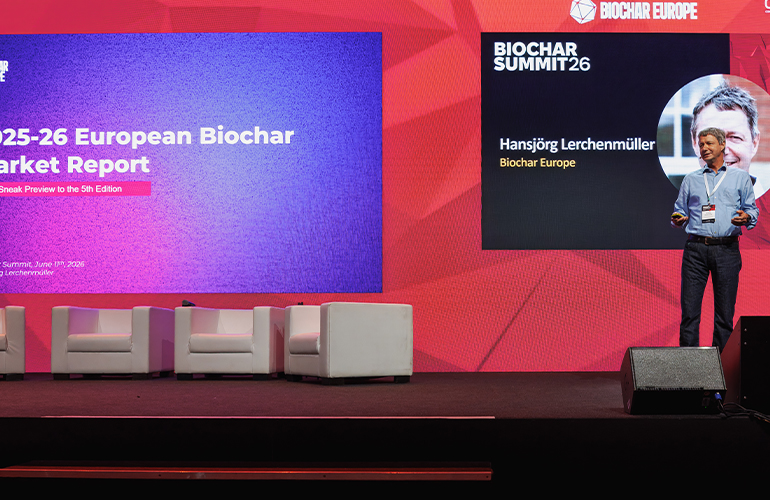
The report finds that there are over 30 technology providers currently on the market in Europe displaying a diversity of technical approaches, which the lead author, Hansjörg Lerchenmüller, Chair of Biochar Europe, noted is a “good thing” during a “sneak preview” of the report at the recently held European Biochar Summit in Vienna, Austria.
Many of these providers are at Technological Readiness Level (TRL) 8 or 9, and the report notes that new equipment suppliers are entering the market.
Applications and emerging value chains
Beyond production figures, the report explores where biochar is gaining relevance across different applications and industrial value chains.
It also looks at the role of Biochar Carbon Removal (BCR), the growing relevance of carbon markets, and the policy signals that could influence how quickly the sector can scale.
From carbon removal and agriculture to construction materials, metallurgy, and other emerging uses, it outlines the questions many companies, policymakers, and project developers are now asking: Where is demand coming from? Which sectors are moving first? What barriers remain? And what will be needed to move from individual projects to wider market integration?
Biochar in the wider policy and industrial context
The report also places the European biochar market within the broader climate and industrial policy context.
It looks at how regulatory frameworks, carbon removal demand, and sector-specific applications could shape the coming years, without reducing the market story to a single trend or data point.
The market report follows hot on the heels of Biochar Europe’s recent white paper, “Decarbonizing the Built Environment with Biochar: A Blueprint“, that looks at how biochar can support practical decarbonization pathways in construction materials.
This paper focuses on the integration of biochar into cement and concrete, while also touching on asphalt, and outlines how biochar can contribute to long-term carbon storage, low-embodied carbon mixes, and the transition from pilot projects to commercial practice.
It brings together technical, regulatory, and project-based perspectives for stakeholders across the construction value chain, from producers and designers to planners, financial institutions, and regulatory bodies.