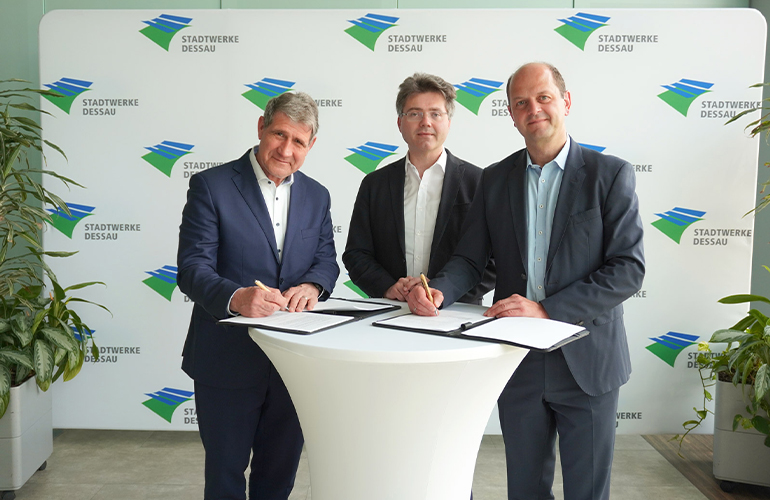
In Germany, municipal energy utility Dessauer Versorgungs- und Verkehrsgesellschaft mbH – DVV – Stadtwerke (Stadtwerke Dessau) has signed a long-term heat offtake agreement with compatriot climate-tech company Novocarbo GmbH and its parent company Hevella Carbon GmbH. As part of this collaboration, Novocarbo plans to develop the Carbon Removal Park Dessau in Dessau-Roßlau that will deliver renewable heat to the district heating network while producing biochar for climate protection.
According to a statement, the Stadtwerke Dessau – Novocarbo agreement covers an annual supply of up to 13.5 GWh of renewable heat, ensuring the economic and continuous operation of the facility, over a period of 15 years from commissioning.
In return, the district heating company Fernwärmeversorgung GmbH Dessau will purchase the green heat generated.
Commissioning is currently planned for no later than January 1, 2028. This will create a reliable, fossil-reduced heat source for the region.
By signing this agreement, we are taking an important next step in developing our heat supply towards climate neutrality. The use of innovative technologies and regional resources sends a strong signal for active climate protection at the local level, said Mayor Dr Robert Reck.
A circular infrastructure approach
At the core of the project is the Biochar Carbon Removal (BCR) process. At the Carbon Removal Park Dessau, biogenic residues such as woodchips or fruit pits are converted via pyrolysis into biochar and renewable heat.
The carbon remains stably bound in the biochar, creating the basis for long-term biogenic carbon dioxide (CO2) storage when used in appropriate downstream applications.
The high pyrolysis temperatures of 600–700°C also generate usable process heat, which is fed into the district heating network.
By utilizing organic residues, the system follows a circular model in which existing resources are repurposed rather than discarded. An approach that is becoming increasingly relevant for municipalities and industry.
Dessau-Roßlau is a strong example of how regional partnerships can drive decarbonization – and how we can further strengthen the region through local biomass processing and energy solutions, said Dr Karl Kolmsee, Managing Director of Novocarbo.
Biochar for Federal Horticulture Show 2035?
In addition to heat generation, Novocarbo produces biochar with a wide range of applications. In agriculture and urban greening, it improves water and nutrient retention, and soil structure while supporting biodiversity.
Against this backdrop, the planned Federal Horticulture Show (BUGA) 2035 in Dessau-Roßlau presents a unique opportunity to showcase forward-looking landscape solutions.
As part of modern substrates, biochar can help create climate-resilient green spaces and soils, while enabling long-term carbon storage in urban environments – making innovative approaches visible and tangible.
Beyond soil applications, biochar also opens up new possibilities in the construction sector.
As an additive in materials such as asphalt, it can partially replace fossil-based inputs and contribute to lower-emission construction materials, while also enhancing material performance.
Supporting the municipal heat transition
The planned facility represents an important building block for climate-friendly heat supply and will reliably complement the existing district heating network.
At the same time, residents of Dessau-Roßlau will benefit from a secure and increasingly renewable heat supply.
The use of unavoidable waste heat from biochar production is a tangible contribution to climate protection. It allows us to gradually replace fossil fuels with innovative heat sources and move our district heating system step by step toward climate neutrality, said Dino Höll, CEO, Stadtwerke Dessau.
The partnership provides long-term planning certainty and supports the continuous expansion of low-emission heat sources in Dessau-Roßlau.
It aligns with the city’s municipal heat planning as well as the transformation plan of Stadtwerke Dessau, which aims to integrate at least 30 percent renewable energy or unavoidable waste heat into the system by 2030.
This builds on the city’s broader energy and climate strategy, which targets a significant increase in the share of renewable energy in overall heat consumption.