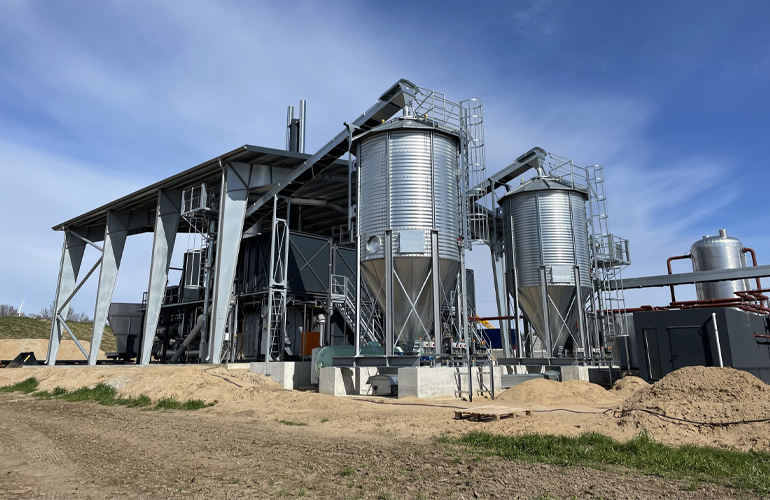
Removing carbon dioxide from the atmosphere while at the same time producing climate-neutral heat – these two important decarbonization measures are combined in the new “Carbon Removal Park Baltic Sea” developed by the German cleantech company Novocarbo GmbH in Grevesmühlen, Germany.
The Paris Agreement climate targets call for carbon dioxide (CO2) emissions to be reduced to net zero. To achieve this, global CO2 emissions must be massively reduced. At the same time, CO2 must be actively removed from the atmosphere through so-called Carbon Dioxide Removal (CDR) technologies.
The Carbon Removal Park Baltic Sea (CDR-Park Baltic Sea) in the green industrial area in northwest Grevesmühlen is a unique example in Germany of a holistic approach to CDR and green heat generation.
Each year 3,200 tonnes of CO2 will be removed from the atmosphere, 6,600 MWh of climate-neutral heat will be generated, and 1,700 tonnes of biochar will be produced, which can be used as a soil conditioner in agriculture, among other things.
Only through flagship projects such as the Carbon Removal Park Baltic Sea can the development potential of new technologies for CO2 removal be exploited to the fullest, can scaling up to large-scale industrial applications succeed, and can the path towards a climate-neutral energy supply be successfully taken. I am convinced that Germany needs such innovative companies as Novocarbo to meet the major challenges of climate change, said Stefan Wenzel, Parliamentary State Secretary at the German Federal Ministry of Economics and Climate Protection.
Showcase plant
The showcase site for Biochar Carbon Removal, seen as one of the world’s most effective CO2 removal technologies, is the result of a unique cooperation of German climate pioneers and combines several climate-saving measures at once.
State-of-the-art pyrolysis technology from German plant manufacturer PYREG GmbH is used to process biogenic residues into biochar. This binds the carbon present in the biomass and stores it in the biochar over the long term.
The biochar serves as a water and nutrient reservoir, making agricultural soils healthier and more climate-resistant, for example.
Bioheat for district heating
The pyrolysis process also produces climate-neutral waste heat, which municipal energy company Stadtwerke Grevesmühlen will feed into its district heating network from the 2023 heating season.
This will make the supply of around 1,800 connected households greener and increase the share of renewable energy from 60 percent to 75 percent.
By using Novocarbo’s climate-neutral waste heat, we can save natural gas as an energy source and make district heating greener for the region. We see great potential here, especially for small and medium-sized municipal utilities, because Novocarbo’s decarbonization technology can be easily adapted and scaled. The energy supplier only builds the heat transport pipeline and saves on additional investment costs, which enables short-term implementation. With cooperations like the one with Novocarbo, the path towards climate-neutral energy supply can succeed in an uncomplicated way, said Jens Wilms, Project Development Stadtwerke Grevesmühlen.
Plans for worldwide rollout of CDR Parks
The cleantech company Novocarbo builds and operates CDR Parks and is one of Europe’s leading suppliers of biochar. The CDR Baltic Sea is the third and largest site thus far of the Hamburg-based start-up.
Companies such as thyssenkrupp rothe erde already rely on Novocarbo’s decarbonization solution. Plans are for the construction of another 200 CDR Parks worldwide by 2033.
Our Carbon Removal Parks can generate climate-neutral heat and at the same time remove CO2 from the atmosphere, thus making an important contribution to achieving the goals of the Paris Climate Agreement. We are pleased to drive the heat transition in Germany through our collaboration with Stadtwerke Grevesmühlen and to support the energy industry in decarbonizing its heat generation. Collaborations between cleantech startups and municipal utilities are the way forward to quickly and successfully deploy decarbonization technologies to achieve net zero goals, said Caspar von Ziegner, CEO of Novocarbo.