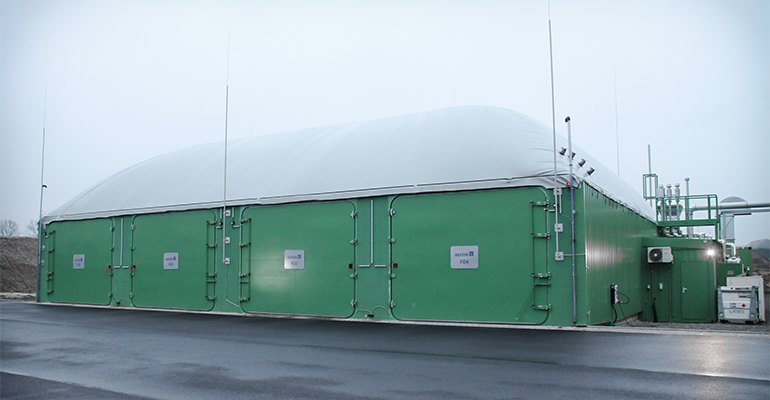
Germany-based Eggersmann Group has announced that its wholly-owned subsidiary, BEKON GmbH, has recently added a newly developed mini dry fermentation plant to an existing composting and transfer station of KOMPOTEC Kompostierungsanlagen GmbH in Enger, Germany. The phased commissioning of the BEKON MINI, as the new system is called, has already been completed with some comparative results to composting.
According to Eggersmann, its BEKON dry fermentation technology offers an option for advanced and efficient biogas production. With a low energy consumption, they achieve a constant, maximum output of high methane content biogas, through fermentation of solid substrates. These include organic and garden waste, organic fractions from residual waste processing, solid cattle manure and other “stackable” organic wastes.
The resulting digestate is “noted for its excellent structural properties” and a comparatively low water content, which makes it ideally suited for aerobic conditioning and further treatment to high grade, nutrient-rich compost or organic fertiliser for soil improvement.
Better GHG reduction and low energy self-consumption
The company says that its recently developed BEKON MINI system enables dry fermentation to be conducted even in the smallest spaces and with low input quantities. The new biogas plant in Enger has an annual input capacity of 8 500 tonnes of biowaste consisting of kitchen and garden waste, from which some 1.1 million Nm3 of biogas can be produced.
This is used both for the generation of electricity and heat, on an annual basis around 1.21 GWh electricity and 1.2 GWh heat respectively. Compared to straight composting of the same material, this allows further greenhouse gas (GHG) emission reductions, approximately 1 050 tonnes of carbon dioxide (CO2) equivalents.
In Enger, only 8 percent of the electricity generated is used for the operation of the biogas plant itself with the remainder fed into the regional power grid. Likewise, only a small fraction of the thermal energy is needed for operation of the plant itself.
At Enger, the recovered waste heat will, in the near future, be utilised externally, for example, through feed-in to a local or district heating network or for use in drying materials.
Currently, some 60 BEKON biogas plants are already in operation around the world. The BEKON MINI plant in Enger is the third biogas plant of this type to be installed, following projects in Galmiz,
Switzerland and Ahrenshöft, Germany with several others now well into the planning and implementing phase.