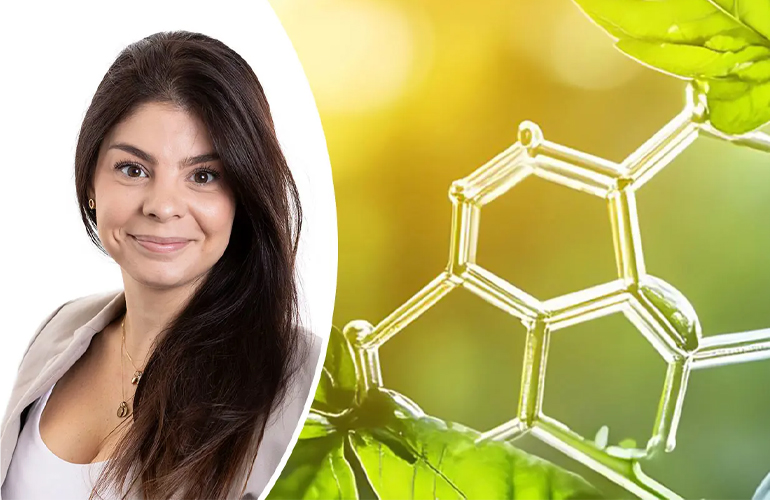
A by-product of the forest industry, lignin can be used to produce sustainable materials that can replace traditional plastics. In a new doctoral thesis, Matilda Johansson from the University of Borås, Sweden, investigated how lignin can be chemically modified lignin and used in fibre-reinforced biocomposites.
In her research project, Matilda Johansson, now holder of a doctorate in Polymer Technology, investigated how lignin can be chemically modified and used in fibre-reinforced biocomposites to create materials that can not only replace oil-based products but also reduce the weight of structures without compromising mechanical properties.
The project has revolved around four key issues:
- How can the compatibility of lignin with other substances be improved?
- How can the modification process be made more efficient and environmentally friendly?
- How can the mechanical and thermal properties of the material be improved?
- How can a fibre be incorporated to further strengthen the material?
The findings have been published in her doctoral thesis “Valorising lignin: A pathway to sustainable and high-performance biocomposites“, which was successfully defended on April 205, 2025.
There are many unexplored possibilities for lignin. By chemically modifying lignin, it is possible to create a material that has great potential to replace oil-based materials, explained Matilda Johansson.
Simple and effective method
The method involves extracting lignin from forest and agricultural waste and chemically modifying it using acetic anhydride and microwaves.
This allows the lignin to bind with other polymers, such as polylactic acid (PLA), enabling methods such as extrusion, 3D printing, and compression moulding to create a composite reinforced with regenerated cellulose fibres.
Environmental benefits and resource efficiency
The project is an important contribution to research on sustainable materials. This demonstrates the importance of developing environmentally friendly alternatives to today’s materials.
The project contributes to minimising the use of traditional plastics, i.e. oil-based materials. The material consists of natural components, and no harmful chemicals are used during production. More and more industries are switching to bio-based alternatives, and this material could be an option to reduce the climate impact. The fact that it also consists of a material that is considered to be a byproduct from another industry, i.e. of low value, makes the whole process more resource efficient, Matilda Johansson said.
With sustainability in focus
The project supports the UN’s Sustainable Development Goals, primarily Goal 9, Industry, Innovation and Infrastructure, and Goal 12, Responsible Consumption and Production.
Today’s high consumption means that there is an incredible amount of material, yet a very small proportion is recycled, resulting in accumulations of material that contribute to a lot of destruction in nature. If it is possible to choose a material that has had less impact on nature when it is produced as well as less impact on nature when it is used, that’s a win-win, ended Dr Matilda Johansson.