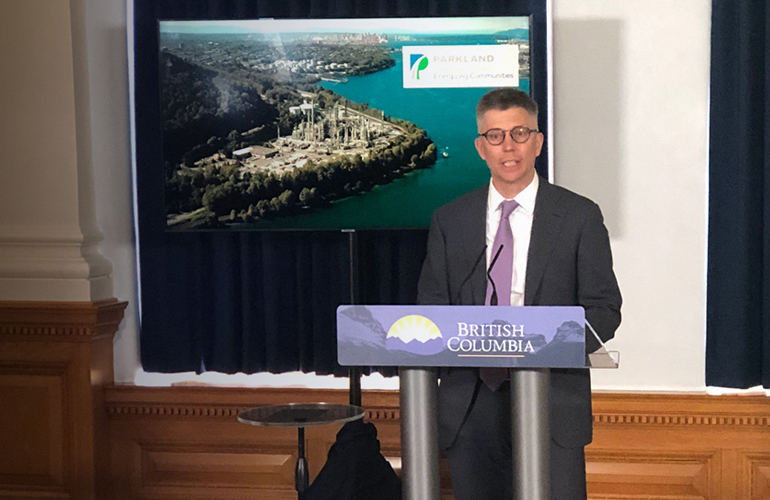
Canada-headed independent supplier and marketer of fuel and petroleum products and convenience store operator, Parkland Corporation (Parkland), has revealed plans to expand its co-processing activities and build the largest renewable diesel complex in British Columbia (BC).
Headquartered in Calgary, Alberta (AB), Parkland operates in fuel retail, commercial and wholesale across Canada, the United States, the Caribbean region, and the Americas.
The company optimizes its fuel supply across these three channels by operating and leveraging a growing portfolio of supply relationships and storage infrastructure in addition to providing electric vehicle (EV) charging, renewable fuels, solar energy and compliance, and carbon offset trading to its customers.
Increase renewable diesel production capacity
According to a statement, Parkland plans to increase renewable fuel production at its Burnaby Refinery in British Columbia (BC).
This includes expanding the existing co-processing volumes to approximately 5 500 barrels per day, and building a stand-alone renewable diesel complex, within the Burnaby Refinery capable of producing approximately 6 500 barrels per day of renewable diesel.
This is one of many steps we are taking to advance our commercial decarbonization strategy and provide our customers with a portfolio of low-carbon products and services to help them meet their low-carbon goals, the statement read.
A CA$600 million investment
If fully realized Parkland’s Burnaby Refinery would become the single largest renewable diesel production facility in the Province.
In addition, Parkland is designing the stand-alone renewable diesel complex to ensure it does not increase emissions from the Burnaby Refinery.
Renewable fuels produced through these plans will have one-eighth of the carbon intensity of conventional fuels. They will reduce related greenhouse gas (GHG) emissions by approximately 2 megatonnes per year the company says.
The announcement follows collaboration with the Government of British Columbia and supports the Government’s ambition to achieve net-zero emissions by 2050.
I applaud the Government of British Columbia for their vision and support of these innovative projects, said Bob Espey, President, and CEO at Parkland.
Parkland currently estimates that these projects will require an investment of approximately CA$600 million, with the majority of capital investment expected to be deployed in 2024 and 2025.
This announcement advances our decarbonization strategy and our commitment to providing customers with low carbon choices which help them meet their environmental goals. Renewable fuels play a critical role in Canada’s climate ambitions by enabling customers to reduce their carbon footprint using their existing vehicles, Bob Espey said
BC Government support
Parkland has received BC Government support for over 40 percent of the project costs in the form of BC Low-Carbon Fuel Standard Compliance Credits.
Parkland’s plans to increase our province’s renewable fuel capabilities support our Clean BC targets. This is a big step forward in our transition to a lower-carbon economy, said Bruce Ralston, Minister of Energy, Mines, and Low Carbon Innovation.
The projects are anticipated to have a positive impact on employment in BC and are expected to directly create up to “1 000 high-quality, family-sustaining jobs” during the construction phase.
Harnessing Parkland’s technical expertise and infrastructure to lower the environmental impact of our transportation is something we can be proud of. When combined with BC’s other sources of renewable power and efforts to electrify the passenger vehicle fleet, we continue to set the bar for Canada, Minister Ralston said.
Following stakeholder consultation, Parkland aims to make a final investment decision in the second half of 2023, with production expected to commence in 2026.
The company is also assessing the feasibility and availability of financial support to produce Sustainable Aviation Fuel (SAF) as part of these plans, in support of decarbonizing Canada’s aviation sector.