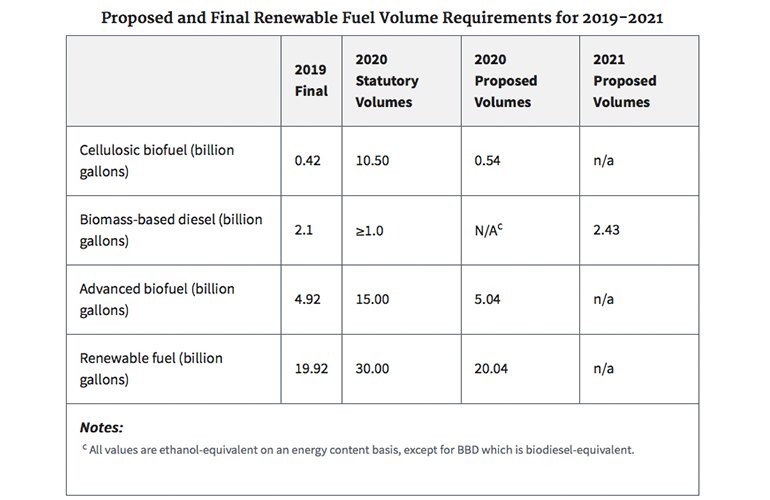
On July 5, 2019, the US Environmental Protection Agency (EPA) Administrator Andrew Wheeler issued a proposed rule under the Renewable Fuel Standards (RFS) program that would set the minimum amount of renewable fuels that must be supplied to the market in calendar year 2020, as well as the biomass-based diesel (BBD) volume standard for calendar year 2021.

The announcement puts EPA on target to publish the final RFS Renewable Volume Obligations (RVOs) on time for the third consecutive year.
Unlike the previous administration, we have consistently issued the annual renewable volume obligations rule on time, which is critically important to America’s farmers and all stakeholders impacted by the Renewable Fuel Standard program. We are on track to meet the deadline on time for the third year in a row and continue to provide greater regulatory certainty to farmers and refiners across the country, said EPA Administrator Andrew Wheeler.
Some key elements of the proposed RVO’s:
- “Conventional” renewable fuel volumes, primarily met by corn ethanol, would be maintained at the implied 15-billion (US) gallon (≈ 56.78 billion litres) target set by Congress
- EPA is proposing an advanced biofuel volume requirement for 2020 of 5.04 billion gallons (≈ 19.07 billion litres), which is 0.12 billion gallons (≈ higher than the advanced biofuel volume requirement for 2019.
- The cellulosic biofuel volume requirement of 0.54 billion ethanol-equivalent gallons (≈ 2.04 billion litres) for 2020 is based on an EPA production projection which is 0.12 billion ethanol-equivalent gallons higher than the cellulosic biofuel volume finalized for 2019.
- EPA is proposing to maintain the biomass-based diesel (BBD) volume for 2021 at 2.43 billion gallons (≈9.2 billion litres).
The Clean Air Act requires EPA to set annual RFS volumes of biofuels that must be used for transportation fuel for four categories of biofuels: total, advanced, cellulosic, and biomass-based diesel.
EPA is using the tools provided by Congress to adjust the standards below the statutory targets based on current market realities. EPA implements the RFS program in consultation with the US Department of Agriculture (USDA) and the US Department of Energy (DOE).