In the United States (US), Syzygy Plasmonics Inc., a deep decarbonization company, has announced an agreement with compatriot nonprofit research institute RTI International to demonstrate sustainable fuel production at RTI's facility in Research Triangle Park in North Carolina. Being sponsored by Equinor Ventures and Sumitomo Corporation of Americas (SCOA), the pilot project aims to demonstrate new technology to convert two potent greenhouse gases, carbon dioxide and methane, into low-carbon-intensity fuels to replace petroleum-based jet fuel, diesel, and gasoline.
Testing is planned for a period of six months, with results from the demonstration to be used to build a techno-economic analysis for constructing a commercial-scale Syzygy eFuels plant.
This demonstration will be the first of its kind and represents a disruptive step in carbon utilization. The sustainable fuels produced are expected to quickly achieve cost parity with today’s fossil fuels. Integrating our technology with RTI’s Fischer-Tropsch synthesis system has the potential to significantly reduce the carbon intensity of shipping, trucking, and aviation without requiring major fleet modifications. By making minor adjustments in the process, we also expect to produce sustainable methanol using the same technology, said Trevor Best, CEO at Syzygy Plasmonics.
Fully electrified DMR
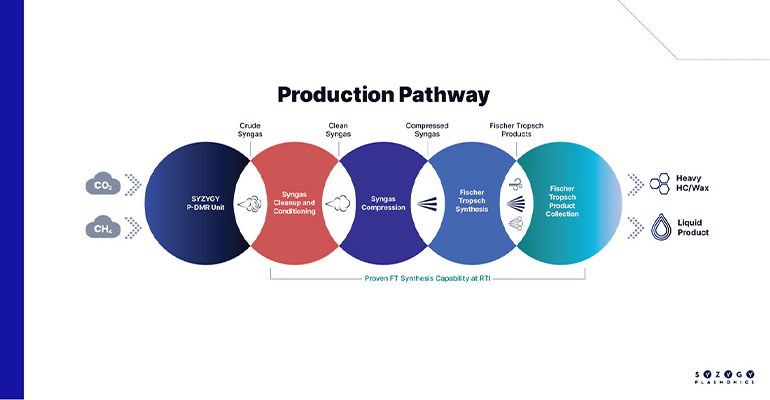
The solution uses a fully electrified reactor provided by Syzygy to produce syngas from carbon dioxide (CO2) and methane (CH4) in a dry methane reforming (DMR) reaction.
The syngas is then processed through a Fischer-Tropsch (FT) synthesis unit to make various fuel grades.
According to Syzygy Plasmonics, the potential of this technology to reduce carbon intensity in fuel could give transportation companies and airlines an affordable solution for cutting emissions and reducing their carbon footprint.
Having already proven its scale-up capabilities in earlier testing of its FT synthesis unit, RTI International is assisting Syzygy with process design and systems integration for this pilot-scale demonstration.
The full production pathway at pilot-scale includes multiple electrified DMR reactors that will consume 27 tonnes of CO2 per annum and produce 6,100 (US) gallons (≈ 23,000 litres) of electrofuels (eFuel).
We are excited about the opportunity to collaborate with Syzygy to test and assist in the scale-up of this promising technology. This work aligns with our capabilities, our goals of helping de-risk and commercialize novel technologies, and our vision to address the world’s most critical problems with science-based solutions, said Dr Sameer Parvathikar, Director of the Renewable Energy and Energy Storage program in RTI’s Technology Advancement and Commercialization business unit.
At commercial scale, this technology is expected to utilize millions of tonnes of CO2 per annum to produce sustainable eFuels.