Though the rapid development of the South Korean pellet market has spurred pellet projects around South East Asia (SEA), its short-term nature and price collapse has driven Thai producers to develop alternative domestic and export markets.
That was one of the general conclusions of the Biomass Pellets Asia Conference held in conjunction with Victam Asia. The one-day workshop-style event attracted around 60 participants across the pellet value chain from Europe and the SEA region.
Rubberwood feedstock
It is no mean task as according to Akarin Vongapirat, CEO, BNS Wood Industry Co., Ltd, the estimated annual production capacity of pellets in Thailand is comparable to that of France or Spain, over 1 million tonnes.
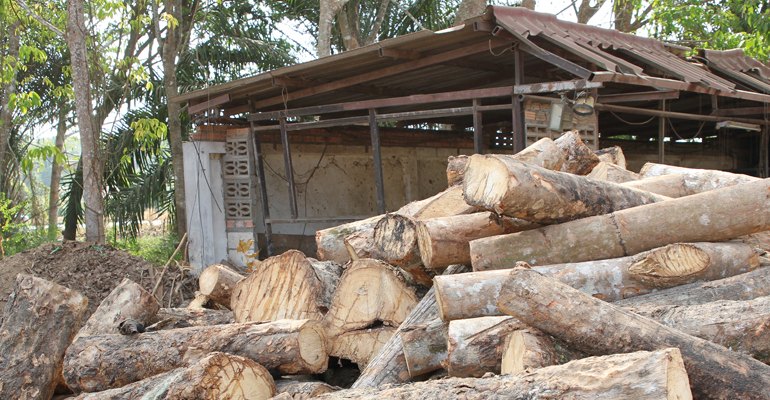
A key feedstock forming the backbone of the Thai pellet industry is rubberwood grown for latex production.
Thailand has 3.55 million ha rubberwood plantations, predominately in the south. However, unlike other agro-commodity crops, it is owned and grown by over 1 million smallholders. This means the average estate is very small, Akarin Vongapira explained.
From a rubberwood feedstock perspective, there is, according to Vongapira, room for expansion of up to 4 million tonnes without affecting existing particleboard and MDF industries and on the current rubberwood estate.
Around 70 000 ha is harvested annually for replacement with new stock. This yields over 12 million tonnes of biomass, Akarin Vongapira said.
Domestic use
In 2009, the Thai government enacted the fifteen-year National Renewable Energies Development Plan 2008-2022 (REDP) to increase the renewable energy shares to just over 20 percent of the country’s total energy mix by 2022.
According to the plan some 9.7 GW of biomass power capacity is to be installed by 2022.
So far domestic utilities favour woodchip and palm kernel shell (PKS), we’ve yet to see a coal-fired power plant co-fire with pellets, ended Akarin Vongapira adding he hoped that this may come about sooner rather than later.