
Contrary to what one may think, carbon capture is not a “new” technology. According to the IEAGHG, a technology collaboration programme (TCP) of the International Energy Agency (IEA), carbon dioxide capture technology has been in use since the 1920s, primarily for separating carbon dioxide from the methane gas occasionally found in fossil gas reservoirs.
Carbon capture and utilisation (CCU) has been around since the 1970s, deploying the captured CO2 for enhanced oil recovery (EOR), while the basic idea of carbon capture and storage (CCS) – capturing CO2 and preventing it from being released into the atmosphere – was first suggested in 1977.
While carbon capture technologies may be proven, it does not mean there is no room for improvement.

Each of the main post-combustion technology pathways – solvent-based scrubbing, semi-permeable membrane, and solid sorbents – has its merits and drawbacks when it comes to capture rates, footprint, pressure rates, scalability, thermal- and electrical energy consumption, to mention a few.
The pathway choice in a given project, which is always site and context-specific, is ultimately a trade-off.
Research is ongoing on several fronts to increase capture rates and/or reduce the energy penalty, e.g., alternative sorbents and solvents.
Furthermore, geological CO2 storage is also a scarce, finite resource, and so policymakers will need to decide, sooner rather than later, how to balance the competing demands of continued fossil fuel use with the need to remove carbon dioxide from the atmosphere.
Continued fossil fuel use into the foreseeable future, as unfortunately, COP30 failed to deliver a concrete plan with binding commitments to phase out fossil fuels.
Herein lies the main criticism voiced against CCUS technologies – that they enable the continued extraction and combustion of fossil fuels when the use of fossil fuels needs to be phased out ASAP.

However, applying a CCS technology to biogenic sources of carbon dioxide, such as emissions from a biomass-fired combined heat and power plant – a plant that has displaced a fossil-fuelled counterpart – it becomes a different story, a case of net CO2 removals from the atmosphere, as the carbon contained in the biomass originated from the atmosphere.
Or in the case of ethanol biorefineries, the capture and sequestration of CO2 from the fermentation process and/or energy used at the plant lowers the carbon intensity of the ethanol produced, whether used for fuel or for other industrial end-products.
In the case of carbon capture and utilisation (CCU), the captured biogenic carbon dioxide (bioCO2) can be used as a feedstock, displacing fossil-derived sources, lowering the carbon intensity of the final product.
Nordic pulp- and paper majors are eyeing the carbon capture opportunity too. Both Finland’s Metsä Group and Sweden’s Södra have disclosed carbon capture plans, in Kemi and Värö, respectively.

Not to forget that numerous biogas plants across Europe that upgrade the biogas to biomethane already valorise the separated bioCO2. And their CCU contribution is not insignificant.
According to the latest European Biogas Association (EBA) data, some 125 plants capture 1.17 million tonnes of bioCO2 annually, equivalent to around 14 percent of Europe’s merchant liquid and solid CO2 (dry ice) demand.
By 2027, carbon capture capacity is expected to exceed 2 million tonnes, with the expansion of gasification, biohydrogen production, or flue gas capture.
By 2040, EU biomethane plants could capture up to 89 million tonnes of bioCO2 annually, more than 25 percent of the carbon capture required to meet the EU Climate Law targets, a significant contribution to the EU’s overall carbon capture goal of 344 million tonnes per year.
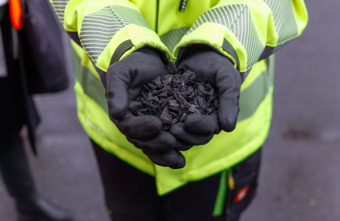
Then there is the biomass torrefaction, pyrolysis, and gasification spectrum for the production of biochar, biocoal, and biocarbon, used for sequestration and displacing fossil carbon in hard-to-abate industries such as metallurgy.
That is the beauty of bioenergy with carbon capture, utilisation and/or storage (BECCUS) with its diversity of scale, technologies, and applications.
A decade has already passed since Bioenergy International first reported on CCU technologies and bioCO2 as a resource; the next decade needs to see a quantum leap in the rollout and implementation of BECCUS in parallel with the phase out of fossil fuels.