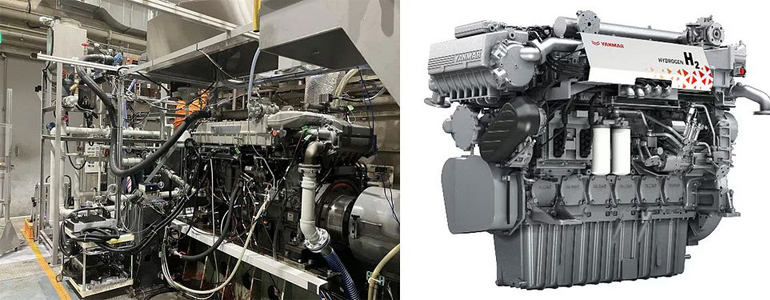
In Japan, Yanmar Power Solutions Co. Ltd, a subsidiary of Yanmar Holdings, has announced that it has become the first engine manufacturer in Japan to obtain both a type approval certificate and an NOx certificate from Nippon Kaiji Kyokai (ClassNK) for its pilot-ignition hydrogen-fuelled 4-stroke high-speed engine for power generation for domestic coastal vessels as part of the Nippon Foundation’s Zero Emission Ships Project.
Led by the Nippon Foundation, the Zero Emission Ships Project focuses on the development of hydrogen-powered zero-emission vessels and supports related technology development.
Within this framework, the consortium involving Yanmar Power Solutions has been advancing hydrogen engine development, while also developing a hydrogen-compatible hybrid-electric propulsion vessel that combines a hydrogen engine generator with batteries.
The vessel design incorporates a container-unit-type hydrogen power generation system on its upper deck. Uyeno Transtech Co. Ltd a shipping company under the Uyeno Group, is responsible for the vessel’s development and construction.
Paving the way for vessel demonstration trials
In 2025, Yanmar Power Solutions was intensifying its land-based demonstration tests utilizing a small amount of hydrotreated vegetable oil (HVO), aka renewable diesel, as a pilot fuel, while preparing for planned demonstration operations.
As a result of the inspection by ClassNK, the company successfully obtained a type approval certificate in October 2025 certifying that the equipment complies with the specified regulations, and an NOx certificate in December 2025, certifying compliance with Tier II in nitrogen oxides (NOx) emissions regulations established by the International Maritime Organization (IMO).
Both certificates are required for demonstration operations, and the engine specifications covered by these certifications are designated as “Electronically Controlled Gas Only Engine (Hydrogen).”
Moving forward, the company will install the necessary equipment, including two hydrogen engines, onto domestic coastal vessels, paving the way for demonstration operation trials scheduled for the latter half of 2026.