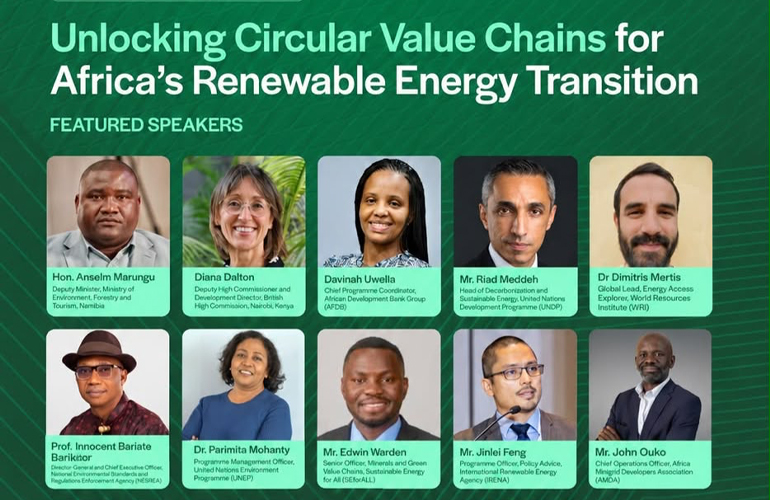
Africa has a unique opportunity to become a global clean-energy manufacturing powerhouse rather than simply supplying the raw materials that fuel the world's net-zero transition. That was the message from Riyad Mehdeb, of the United Nations Development Programme (UNDP), to academics, policymakers and government ministers at a virtual conference co-hosted by the UK's Warwick Business School and the Circular Economy Powered Renewable Energy Centre (CEPREC), a Pan-African, multisectoral Research Centre of Excellence committed to advancing Africa’s energy transition and funded by UK Research and Innovation (UKRI) through the UK Government’s £1 billion Ayrton Fund.
In his address, Riyad Mehdeb told participants at the virtual Pan-African policy conference, “Turning the Lights On: Unlocking Circular Value Chains for Africa’s Renewable Energy Transition“, that the continent must move beyond its traditional role as a supplier of critical minerals and energy resources and become a producer of the technologies needed for the low-carbon economy.
Africa is increasingly manufacturing for the world’s energy transition, while importing for its own. 94 percent of solar panels installed in Africa is imported from China, while much of the new manufacturing capacity is built for export. Those imports cost US$2.4 billion in the 12 months to June, said Riyad Mehdeb.
Mehdeb added that there is a circle: “who maintains these assets, and where does the value go? And this is why I want to use the phrase ‘circular value chain’ in its wider sense, because what is at stake is the development model itself. The old model exported raw materials, imported finished goods, and burned imported fuel to run both.”
The new model starts from the energy source. Africa has more than anyone else. If we keep electricity, data, credit, skills and materials circulating at home, then that is how an energy transition becomes green industrialisation. Cheap solar power and cheap AI are arriving together, and Africa can use one to build the other. The sun can power the data, the data can keep the solar working, Riyad Mehdeb explained.
With demand for renewable technologies accelerating across the world, speakers argued that African nations are well positioned to capture a greater share of the economic value created by the energy transition through investment in manufacturing, innovation, recycling and regional supply chains.
Africa holds around 60 percent of the world’s solar resources yet attracts only a small proportion of global energy investment, while most renewable-energy equipment continues to be sourced from overseas.
According to Mr Mehdeb, the solution lies in building stronger local value chains that allow African countries to manufacture, repair and recycle clean-energy technologies closer to home.
Africa is about to be the largest clean energy system the world has yet seen. The strategic question is where its value settles. If it is Africa, the continent can lead on a different development model. Energy produced at home, AI that works on its own languages, capital priced on its record, and industry built where the mineral and the young workforce already are, Riyad Mehdeb said.
Rather than viewing the transition purely through an environmental lens, speakers described it as an opportunity to drive industrialisation, create jobs and strengthen long-term economic resilience.
The conference also heard evidence challenging perceptions about investment risk on the continent.
Riyad Mehdeb noted that African infrastructure loans have some of the lowest default rates globally, at around two percent, suggesting there is a stronger case for investment in clean-energy projects than is often assumed.
Alongside manufacturing, delegates highlighted the importance of developing a circular economy for renewable technologies.
With growing numbers of solar panels, batteries and electronic devices reaching the end of their life, speakers argued that Africa has an opportunity to establish industries focused on repair, reuse and recycling.
Giuliana Battisti, Co-Director of CEPREC and Professor of the Economics of Innovation at Warwick Business School, stressed that the energy transition must deliver economic as well as environmental benefits.
Africa should focus on developing leadership in energy generation, thinking of what can be produced in Africa. So how do we do this? Giuliana Battisti asked delegates.
According to Giuliana Battisti, developing coherent national policies that focus on centres of excellence, attracting talent that has studied overseas, and encouraging them to come home and develop local solutions.
This needs to be surrounded by a financial ecosystem that takes ideas to market.
Africa doesn’t want to rely on technological dependence on overseas, but can launch its own competitiveness, becoming a leader in energy generation. Setting up the energy infrastructure is the foundation of any economic development. The circular economy can provide enormous opportunities. Developing countries are locked into the old system of production, but Africa is not. It has the local capability and skills, but the technology needs to be produced, invented, and embedded into the African system. Africa can develop unique competencies and capabilities in developing new materials, new purposes, and move up the value chain, Giuliana Battisti said.
Aslem Marungu, Deputy Minister, Ministry of Environment, Forestry and Tourism for Namibia, highlighted the importance of building local manufacturing and recycling capacity.
Africa must not only be a consumer of renewable energy technologies. We must also be an active creator, recoverer and beneficiary of the value chains that sustain them, Aslem Marungu said.
Diana Dalton, Deputy High Commissioner in Kenya, argued that with the right investment and policy support, African countries could become leaders in circular innovation, sustainable manufacturing and green industrial development rather than remaining dependent on imported technologies.
If you get all of those things right, then Africa becomes not a consumer of renewable energy technologies, but really a leader in circular innovation, sustainable manufacturing and green industrial development, Diana Dalton said.