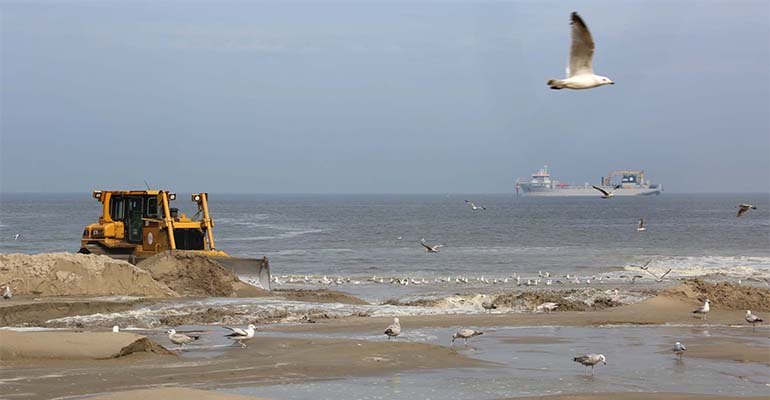
Belgium-headed dredging and offshore construction major Jan De Nul Group has revealed its commitment to reduce carbon dioxide (CO2) emissions by 15 percent a year during maintenance dredging works at the Nieuwpoort coastal marina. It is the world's first dredging company to aspire to such a reduction in a commercial project application.
In collaboration with the Flemish government, the company also wants to include by 2020 a minimum requirement of 15 percent carbon dioxide (CO2) reduction in 80 percent of maintenance dredging contracts in Flanders.
Upon issuing an invitation to tender for the maintenance dredging works in the Nieuwpoort coastal marina, the Flemish governmental Agency for Maritime and Coastal Services (MDK) gave the market maximum opportunities to focus on CO2 reduction through innovation.
Jan De Nul Group won the contract by promising to reduce CO2 emissions by 15 percent annually. This is unprecedented in the sector. Never before has a dredging company aspired to such a CO2 emission reduction target in a commercial application for a project.
Drop-in biofuel
Jan De Nul Group is focusing in particular on drop-in biofuel to achieve the ambitious CO2 reduction target. This is a high quality, sustainable replacement of fossil diesel, made of vegetable oils or waste flows without the need to modify existing engines or the refueling infrastructure.
Furthermore, not only are CO2 emissions reduced, but far less soot is released in the air. Drop-in biofuel burns more efficiently than conventional diesel. Because drop-in biofuel uses waste flows as raw material, it is also beneficial to the circular economy. Finally, it is a very clean fuel that is extremely suitable for high-grade engines.
With this approach and by choosing Jan De Nul Group, the Agency for Maritime and Coastal Services (MDK), within the Department of Mobility and Public Works, has showcased its pioneering profile within the Flemish government to achieve the reduction targets. Under the Paris Climate Agreement, Belgium has committed to reducing CO2 emissions by 15 percent by 2020.
As a maritime authority within the Flemish government, we want to focus on reducing our environmental footprint in every possible way. We, therefore, pay particular attention to green criteria when we define specifications for the market. This already leads to concrete CO2 reduction today, particularly by paying attention to ecological performance during dredging works and to the contractors with whom we cooperate. The MDK pays attention not only to climate requirements when drawing up procurement contracts. We assume our responsibility in the way we work as well. We are greening our own vessels as well in order to reduce our CO2 emissions. For instance, we are in the process of building an electric boat, said Nathalie Balcaen, CEO, MDK.
Reducing CO2 sector-wide
The project also is in line with Jan De Nul Group’s aspiration to play a pioneering role and to roll out a sector-wide CO2 emission reduction programme. The dredging company wants to have a minimum 15 percent CO2 reduction requirement introduced in 80 percent of maintenance dredging contracts in Flanders by 2022.
We want to make the utmost effort and, in doing so, inspire other companies in our sector to focus on energy or CO2 reduction measures. We are therefore delighted to be engaged in dialogue with the Flemish government and the non-profit organization Vlaamse Waterbouwers VZW, and are working closely together with Zero Emission Solutions and the advanced sustainable fuel sector, said Bart Praet, Head of Dredging Works Benelux department at Jan De Nul Group.
The announcement of the targets comes shortly after the Flemish Government’s decision to agree to a three-year pilot project for testing the CO2 performance ladder for government contracts. This ladder was developed in 2009 in the Netherlands as an instrument and certification scheme to stimulate CO2 reduction and turned out to be very successful.
The Flemish pilot project will kick off in September 2019 and last until September 2022. The expected result is that contractors will be awarded contracts if they offer maximum quality, minimal CO2 emissions, and a fair price.
We are convinced that Jan De Nul can play an absolute pioneering role. We want to be one of the first contractors to make a significant contribution to the Flemish pilot project as well as one of the first to achieve actual CO2 reduction in a project. Our project in Nieuwpoort is a concrete example of how we wish to launch a dialogue on reduction requirements. We want to encourage our sector to quickly and forcefully come up with energy and CO2 reduction measures through innovation, said Bart Praet.