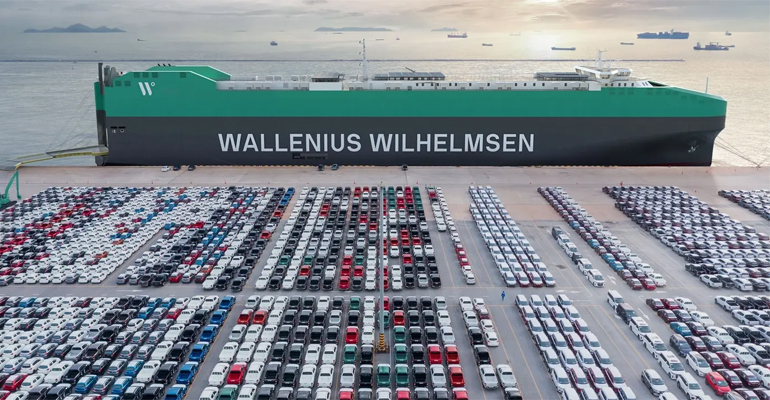
Norway-headed oil, gas, and energy major Equinor ASA has announced that it has entered into a two-year bio-methanol supply agreement with compatriot Wallenius Wilhelmsen ASA, a major global player in shipping and vehicle logistics, supporting a growing marine segment for low-carbon fuels.
Soon, bio-methanol from Equinor will fuel vessels carrying cars and machinery from points of production to markets.
Wallenius Wilhelmsen is a market leader in roll‑on/roll‑off (RoRo) shipping and vehicle logistics and will use bio‑methanol as bunker fuel for its upcoming dual‑fuel methanol vessels.
Wallenius Wilhelmsen will receive the bio-methanol bunkers at the Ports of Zeebrugge and Antwerp in Belgium, positioning the partnership within key European maritime hubs. Supplies will commence in late 2026.
We continue to see increasing interest in bio-methanol as a practical, scalable solution for decarbonisation of shipping. This partnership with Wallenius Wilhelmsen marks a substantial step forward in bringing Equinor’s bio-based methanol to the growing marine segment for low-carbon fuels. Equinor has previously signed supply agreements for bio-methanol with Maersk and NCL, and we are progressing several leads for both bio and conventional methanol supply agreements, said Alex Grant, SVP of Crude, Products and Liquids (CPL) at Equinor.
The use of bio-methanol will enable substantial reductions in greenhouse gas (GHG) emissions from ships that use the fuel and help Wallenius Wilhelmsen provide net-zero logistics solutions to its customers.
Signing this deal with Equinor marks an important milestone for us at Wallenius Wilhelmsen. Securing low-carbon bio-methanol supports the decarbonization of our ocean operations, while strengthening our ability to deliver lower-emission end-to-end logistics for customers. Partnerships like this are essential to scaling alternative fuels and moving from ambition to execution, said Xavier Leroi, COO of Shipping Services at Wallenius Wilhelmsen.
Mass-balance approach
Equinor’s supply of bio-methanol is based on a combination of methanol produced at Equinor’s facility at Tjeldbergodden, Norway, and biomethane certificates in accordance with the EU Renewable Energy Directive (RED).
The methanol is produced from biomethane in the gas grid on a mass-balance basis. This way, methanol can be produced in existing facilities using existing infrastructure and plants, enabling quick production while also allowing for less pressure on pristine land, natural resources, and the environment.
The method also enables the capture of methane emissions that would arise from the manure feedstock if left unprocessed.