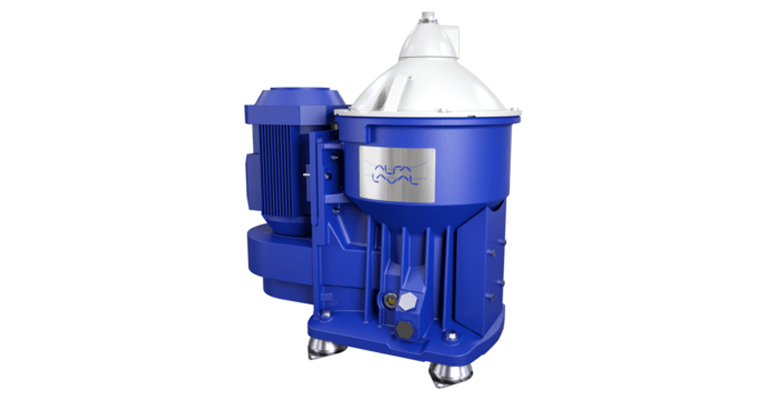
Sweden-headed Alfa Laval AB, a global provider of heat transfer, separation, and fluid handling products has announced the launch of biofuel-optimized separators and separator upgrades for the marine industry.
Biofuels are a current and accessible fuel option that can help marine customers decarbonize. Yet while biofuels reduce the carbon dioxide (CO2) footprint, they also pose new operational challenges.
According to Alfa Laval, the company is the first in the market to address these challenges with biofuel-optimized separators and separator upgrades.
Assured compatibility with leading biofuels
Biofuels like renewable diesel aka HVO (hydrotreated vegetable oil) and biodiesel aka FAME (fatty acid methyl ester) can be used by diesel engines without major engine modifications.
However, they must still be cleaned effectively to prevent performance issues and expensive engine wear.
In a first for the marine industry, Alfa Laval high-speed separators are now compatible with HVO (EN15940) and with FAME (EN14214 or ASTM D6751) blends comprising residual fuel and/or distillate.
We are proud to support our customers’ decarbonization journey, no matter which fuel path they take. Biofuels will be the choice for many marine vessels, but customers must be certain that their equipment is prepared for them. With biofuel-ready separators and cost-efficient biofuel upgrades, Alfa Laval can provide that certainty, said Dr Markus Hoffmann, Global Sales Manager, Marine Separation & Heat Transfer Equipment, Alfa Laval.
Prepared for biofuel complexity
Biofuels are already in widespread use, and ISO – International Organization for Standardization is looking to incorporate them into the 2024 revision of ISO 8217.
Nevertheless, biofuels are produced in various ways and differ widely in their characteristics – both from conventional fuels and from each other. For example, there are differences in density, and moisture absorption. Moreover, they demand additional care when it comes to fuel storage and treatment.
To ensure optimal biofuel separation, Alfa Laval has modified both internal bowl components and the separator software. This makes setting up for HVO, FAME blends, or conventional fuels a simple parameter change.
Incorporated into new Alfa Laval biofuel-optimized separators, the developments are also available as upgrades for existing separators.
Optimizing for biofuels is nothing that occurs overnight. Our biofuel-ready separators build on deep fuel insights, extensive research at the Alfa Laval Test & Training Centre, and long cooperation with ISO and CIMAC. As biofuels continue to evolve, customers can count on Alfa Laval for efficient engine protection, just as they have done with conventional marine fuels, ended Dr Markus Hoffmann.