
In the UK, global resource management company Veolia is helping Scottish Water to achieve net zero by increasing the amount of renewable energy generated at Scotland's largest Wastewater Treatment Works, the Seafield wastewater treatment plant (WWTP) in Leith, Edinburgh.
Since June 2022 Seafield wastewater treatment plant (WWTP) has been a net exporter of renewable electricity producing over 108 percent of the electricity it requires to run the site, with generation on some days being in excess of 125 percent of the site’s needs.
This equates to Seafield exporting enough renewable electricity to power over 800 homes every single day during this period and is the first time the site has been a net exporter for such a prolonged period.
A key milestone for the wastewater treatment sector
Seafield WWTP treats wastewater for a population equivalent (PE) of approximately 850 000 people from Edinburgh and the surrounding area which equates to 300 million litres of wastewater every day.
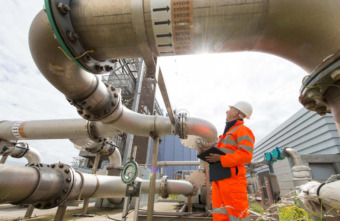
As the UK water industry is the fourth most energy-intensive sector and uses around 3 percent of UK-generated electricity for pumping, water treatment, and waste management, achieving energy self-sufficiency is a key milestone.
By implementing a range of innovations covering anaerobic digestion (AD), thermal hydrolysis, and 3.9 MWe of combined heat and power (CHP) technologies, the site produces its own renewable biogas supply from the WWTP and uses this to generate renewable electricity and heat to support the site’s operations.
The success of the energy plant has enabled the site to exceed its target of energy self-sufficiency, take pressure off the grid, and cut carbon emissions and energy costs.
Recent estimates indicate that the water industry could be self-sustaining for electricity by harnessing the 11 billion litre annual flow of wastewater. Our application of technology to this process at Seafield demonstrates how we can help deliver greater sustainability, make a significant contribution towards delivering renewable energy targets, and take pressure off the National Grid, said Gavin Graveson, SEVP Northern Europe Zone at Veolia.
Additional circular economy benefits
A further benefit of the processes is the nutrient-rich by-product, digestate, it produces which can be used by farmers as a fertilizer.
Around 36 000 tonnes of this is produced each year and act as a low-cost, highly effective alternative to traditional chemical-based fertilizers that are normally used to provide vital soil nutrients for agriculture.
This effectively lowers the need for carbon-intensive synthetic soil improvers which can help reduce the carbon footprint of food production.
Scottish Water has one of the most ambitious Net Zero emission targets in the industry. We are a very large energy user and achieving energy self-sufficiency at a site like Seafield is a key milestone for us, said Gordon Reid, Net Zero Emission General Manager at Scottish Water.
In becoming the benchmark company for ecological transformation, Veolia is committed to tackling climate change, resource depletion, biodiversity collapse, and pollution.
By expanding the use of existing and new innovative solutions, the company is accelerating the process to radically change patterns of production and consumption and placing ecology at the heart of every process.
This achievement really demonstrates what is possible now, and the future shows even greater potential for this technology. If all available 130 million tonnes of untreated feedstocks, such as wastewater, agricultural slurry, food, and green waste were treated through anaerobic digestion (AD) this could supply renewable electricity equivalent to powering 10.2 million homes, ended Gavin Graveson.