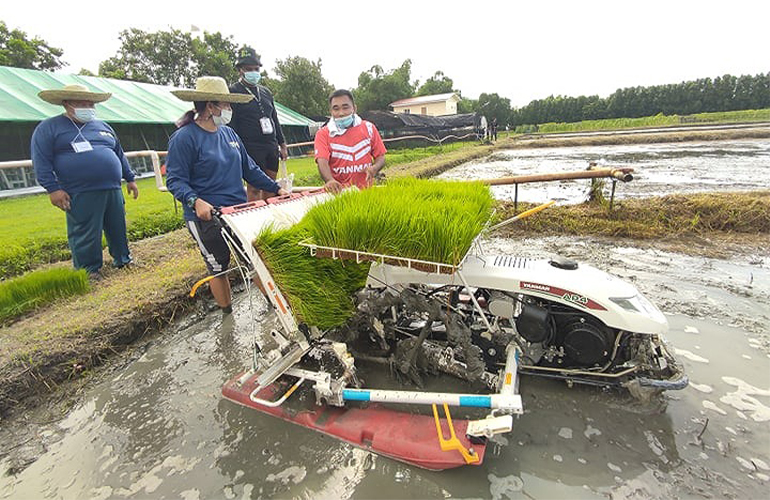
In the Philippines, Yanmar Agri Co., Ltd, a group company of Yanmar Holdings, and its local subsidiary, Yanmar Philippines Corporation, have agreed to collaborate with Faeger Corporation in efforts to reduce methane emissions from rice paddies in the Philippines using the water management method known as Alternate Wetting and Drying.
In the Philippines, methane from rice paddies is estimated to account for approximately 20 percent of the total greenhouse gas (GHG) emissions from across all industries according to data from CLIMATE WATCH and researched by Yanmar.
Therefore, there is an increasing need to reduce methane emissions from rice paddies.
Agricultural JCM project
Japan’s Ministry of Agriculture, Forestry, and Fisheries is promoting the utilization of the Joint Crediting Mechanism (JCM) in the agricultural sector supported by a Measurement, Reporting, and Verification (MRV) system to encourage widespread use of the AWD method in the ASEAN region and reduce methane emissions.
Yanmar Agri and Yanmar Philippines will collaborate with Faeger to accelerate the adoption of these systems.
The efforts aim to ensure income for local agricultural producers through the creation of carbon credits and to advance decarbonization in the agricultural sector.
Facts
About Alternate Wetting and Drying
Alternate Wetting and Drying (AWD) is a water management technique used in rice cultivation. Rice paddies in the Philippines are typically continuously flooded, which promotes the activity of methane-producing bacteria in the soil.
AWD involves periodically drying the rice paddies and supplying oxygen to the soil, thus inhibiting the activity of these bacteria and reducing methane emissions compared to constant flooding.
Additionally, conventional rice cultivation requires large amounts of water to maintain the flooded state, which poses a challenge in regions with insufficient water resources.
AWD significantly reduces water usage by intermittently drying the paddies. It is also expected to reduce fuel consumption by water pumps. This method is gaining attention for its potential to reduce greenhouse gas emissions.
Project overview
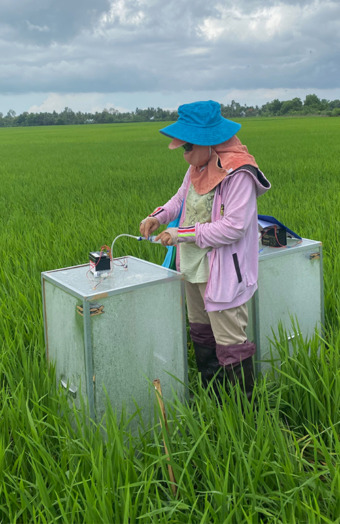
In this project, Yanmar Agri, Yanmar Philippines, and Faeger will collaborate to verify methane emission and reduction levels in the Philippines’ rice paddies through demonstration tests.
They will also simulate farmer income from the creation of carbon credits.
Leveraging the network of farmers and agricultural stakeholders across the Philippines, developed through the sales of agricultural machinery by Yanmar Agri and Yanmar Philippines, and utilizing Faeger’s expertise in carbon credits, the project aims to generate carbon credits in cooperation with local producers.
In addition, the Yanmar Group will use the credits generated through this initiative for carbon offsetting efforts.
This approach will contribute to the development of sustainable agriculture that balances environmental impact reduction with increased producer income.
Demonstration tests are set to commence around November 2024 to promote early adoption of the system and realize the benefits of decarbonization.