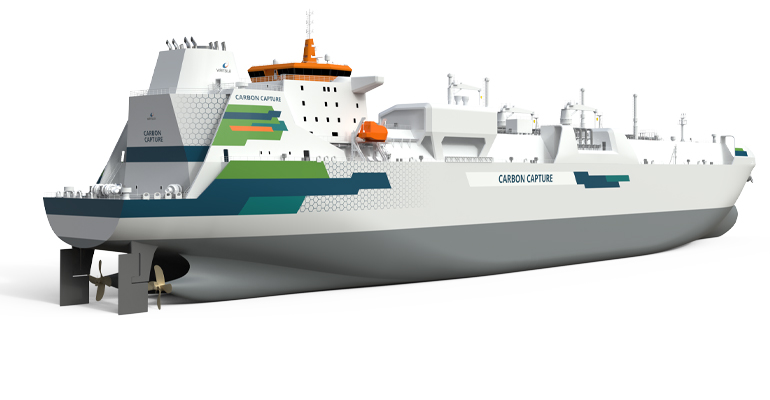
Finland-headed technology group Wärtsilä Oyj has announced that its breakthrough carbon capture solution (CCS) is now commercially available to the global maritime industry, delivering a step-change in shipping’s decarbonisation journey.
According to Wärtsilä’s tests, the new ‘Wärtsilä Carbon Capture Solution’ is proven to reduce vessel carbon dioxide (CO2) emissions by up to 70 percent, providing ship owners with an immediate solution to meet increasingly stringent environmental regulations.
The ability to capture CO2 from ship exhaust systems will have a major impact on the industry’s efforts to reduce greenhouse gas (GHG) emissions, taking into account the International Maritime Organization’s (IMO) 2050 reduction target.
CCS is a game-changer for the maritime industry, and we are already seeing huge interest in the market for this solution. Ahead of shipping’s net-zero targets, this new technology complements the industry’s ongoing efforts to dramatically reduce emissions from vessels and prevent stranded assets, said Håkan Agnevall, President and CEO of Wärtsilä.
World’s first full-scale onboard Clipper Eris
The launch follows the successful installation of the world’s first comprehensive, full-scale solution onboard Solvang ASA’s Clipper Eris, where the technology captures emissions from all exhaust gas sources.
Earlier this year, Wärtsilä installed its CCS technology onboard the 21,000 m3 ethylene carrier for full-scale testing and optimisation.
The solution, which has been in operation since the Clipper Eris set sail from Singapore in February 2025, will support Solvang’s commitment to reducing carbon emissions and promoting sustainable maritime operations.
Solvang’s Clipper Eris ship was already equipped with a broad range of Wärtsilä products, including exhaust scrubbers, making it an ideal candidate for the project.
Separately, for newbuild vessels currently under construction, Solvang has worked closely with Wärtsilä and other partners to ensure these ships are CCS-ready.
This includes CCS-ready scrubber systems, as the engines will operate on heavy fuel oil (HFO), as well as necessary space reservation and utility requirements.
While the shipping sector continues to explore options for lessening its environmental impact, CCS provides a significant shortcut for achieving meaningful sustainability. Solvang has been at the forefront of advocating for and adapting to new technologies such as CCS for our deep-sea fleet. As one of the more promising solutions for marine decarbonisation, it was important for us to team up with an experienced and trusted partner such as Wärtsilä, and we are excited about the potential its CCS offering will bring to our business, said Edvin Endresen, CEO of Solvang.
Developing CCS since 2019
Wärtsilä has been actively developing this technology since 2019 and currently operates a research centre and test facility in Moss, Norway, capturing 10 tonnes of CO2 per day from a Wärtsilä marine engine.
These tests, which are now supported by the full installation onboard Clipper Eris, have proven that the new CCS technology can reduce a vessel’s CO2 emissions by up to 70 percent.
Wärtsilä also estimates its CCS would have a carbon capture cost of EUR 50 – 70 (≈ US$54 – 76) per tonne of CO2, inclusive of capital and operating costs.
Collaboration has been key here. To achieve this significant advance in maritime emissions control, it is important to be able to cooperate with like-minded partners such as Solvang. We congratulate them for their vision and support in bringing CCS to their fleet, Håkan Agnevall said.
Suitable for retrofits and newbuilds
Wärtsilä offers different scalable CCS sizes and configurations to suit various vessel types and operator needs, both on newbuilds and retrofits.
Wärtsilä’s CCS can be applied to the exhaust from any carbon-based fuel, such as heavy fuel oil (HFO), methanol, liquefied natural gas (LNG), and marine gas-oil (MGO) – and is designed to work alongside other emission reduction technologies, including SOx scrubbers, NOx reduction systems, and particulate matter (PM) filters.
As part of Wärtsilä’s broader portfolio, the carbon capture solution can be integrated with other decarbonisation technologies and services.
Wärtsilä’s years of experience in SOx scrubbing and installing technologies that tackle pollutants at the point of exhaust put the company in a unique position to pioneer maritime applications for CCS, and further unlock decarbonisation benefits for owners and operators.