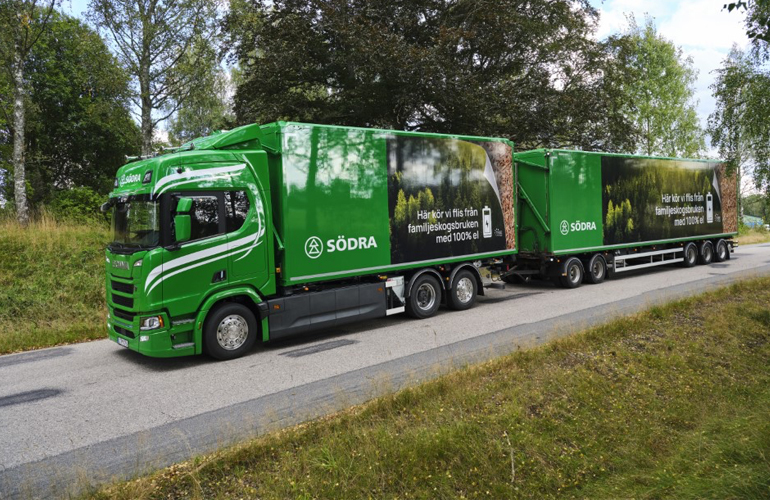
In 2024, Swedish forest owners' association Södra decided to invest in a heavy-duty electric vehicle (HDEV) to be integrated into the company's logistics chain. The electric woodchip truck is now being put into operation within the production activities, and its use will be evaluated under real conditions over the coming two years. This initiative will reduce the environmental footprint of woodchip transportation and represents an important step on Södra's path towards climate neutrality.
According to Södra, the decision to invest in a heavy-duty electric vehicle (HDEV) is part of the forest industry major’s long-term strategy to transition to fossil-free transport and gather experience for future electrification of its vehicle fleet.
Supplied by Scania, the electric woodchip truck will be charged with self-produced fossil-free electricity and used for transporting woodchips in Blekinge and eastern Småland in southern Sweden.
Södra is now initiating an evaluation period that extends until 2027, with a planned daily driving distance of approximately 400 kilometers.
The evaluation will analyze the vehicle’s performance, identify areas for improvement, and facilitate planning for a larger-scale electrification of Södra’s vehicle fleet.
With the electric woodchip truck, we are taking an important step towards fossil-free transportation in the forestry industry. We have already invested in expanding the charging infrastructure to meet the needs of heavier transport. By now testing the technology in our daily operations, we are gathering valuable experiences that can contribute to a more sustainable future, both for Södra and for society at large, said Henrik Brodin, Project Manager for large-scale electrification at Södra.
Part of the TREE Project
The electric woodchip truck and the associated evaluation are part of the TREE collaboration project, coordinated by Skogforsk, the forestry industry’s joint research institute.
The project’s goal is to ensure that 50 percent of all new trucks in the forestry sector are electrified by 2030.
Together with 22 partners, including other forestry companies, hauliers, technology companies, and research institutes, Södra contributes knowledge that can create value for the entire industry.
TREE is funded by Vinnova, through its FFI (Strategic Vehicle Research and Innovation) program.
High capacity and efficient charging
The HDEV is a Scania 45R with a load capacity of up to 64 tonnes and a range of 250-300 kilometers per charge.
It is equipped with three integrated electric motors, generating 610 hp, and has a battery capacity of 624 kWh, making it well-suited for regional transport.
Charging with a power of up to 375 kW enables a charging time of about one hour for normal operation.
The HDEV will be deployed on regular routes and will be a natural part of Södra’s truck fleet. As part of the evaluation, route optimization and the vehicle’s performance will be carefully analyzed.
The results from the project will then form the basis for planning a large-scale electrification of Södra’s vehicle fleet.
Over the past year, Södra has implemented an extensive expansion of the charging infrastructure at its facilities in Mörrum, Mönsterås, Orrefors, and Långasjö.
This is a preparatory measure to handle the charging of HDEVs as part of regular operations. The Swedish Energy Agency has granted a subsidy of SEK 5.2 million (≈ EUR 475,000) for the charging stations.
Part of Södra’s path to climate neutrality
The new HDEV is just one of Södra’s initiatives to promote fossil-free transportation.
At the end of 2024, the first HDEV was introduced as part of another pilot project, this time for transporting pulp from Södra’s Värö pulp mill to terminals in the Port of Gothenburg and Port of Varberg.
Södra says that it “aims to be a leader in society’s journey towards climate neutrality. In this ambition, climate benefits should increase along the entire value chain – from family forestry to the products created.”
To achieve its climate goals, the Group is working to identify potential improvements in operations and sees “great opportunities in the electrification of work machines and transport.”