As the United States (US) recognizes National Agriculture Month, the American Biogas Council (ABC) has released new data showing American farms are capturing 166 percent more biogas – a source of energy created by recycling organic waste like manure and food scraps – than they were just five years ago. Yet most of the nation’s potential to produce domestic energy from agricultural waste on farms remains untapped.
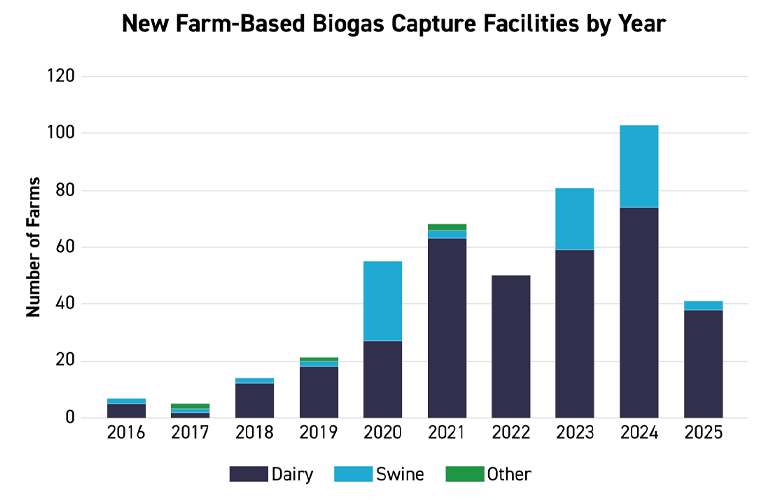
According to the ABC, 631 farms today operate biogas capture systems – more than double the number in 2020.
Those farms can produce over 61 million MMBtu of energy annually, compared to about 23 million MMBtu five years ago.
In 2025, 41 new systems came online, representing US$835 million in investment. Total investment in farm-based biogas capture systems has now reached US$6.4 billion.
Biogas projects convert manure, wastewater, food waste, and captured landfill gas (LFG) into biomethane – aka renewable natural gas (RNG) – as well as renewable heat, power, and nutrient-rich biofertilizer.
These systems also process 25 billion (US) gallons (94.6 billion litres) of manure annually, reducing methane emissions, improving air and water quality, and recycling nutrients back into agricultural soil.
Biogas capture systems recycle everyday agricultural waste into reliable, around-the-clock energy while delivering real economic benefits to rural communities. This technology is one of the most scalable, immediate opportunities we have to expand domestic energy production. With the right policies and continued investment, this sector can deliver transformative benefits for farmers, communities, and the entire country, said Patrick Serfass, Executive Director, ABC
Dairy farms dominate
Dairy farms account for the majority of farm-based biogas capture systems (79 percent), followed by hog farms (19 percent).
A smaller number of systems recycle poultry manure or crop residues. Together, the energy these systems generate annually is enough to meet the needs of approximately 800,000 average American homes.
Use of this energy has shifted since 2020, when almost three-quarters (74 percent) of biogas capture systems generated on-site power.
Today, roughly two-thirds of these systems produce renewable natural gas (RNG) for pipeline injection or as transportation fuel, resulting in significant reductions in air pollution.
California, the nation’s largest agricultural state, accounts for more than a quarter of all farm-based biogas capture systems, most of which capture energy from dairies. Wisconsin represents 9 percent of facilities, followed by New York and North Carolina with six and five percent, respectively.
Significant opportunity
Despite this growth, much of the opportunity remains untapped. Nearly 3,000 American dairy farms with herds of 500 or more could support biogas capture systems, but do not, leaving about 86 percent of the potential undeveloped.
In contrast, in the hog farming sector, fewer than 2 percent of hog farms that could support biogas capture systems have adopted the technology.
If fully realized, US agriculture could produce enough additional biogas to meet the energy needs of approximately 7.7 million homes, enough to power nearly all the households in New York State.
With continued investment and supportive policies, farm-based biogas can deliver more energy, fertilizer, and economic benefits for rural communities nationwide.